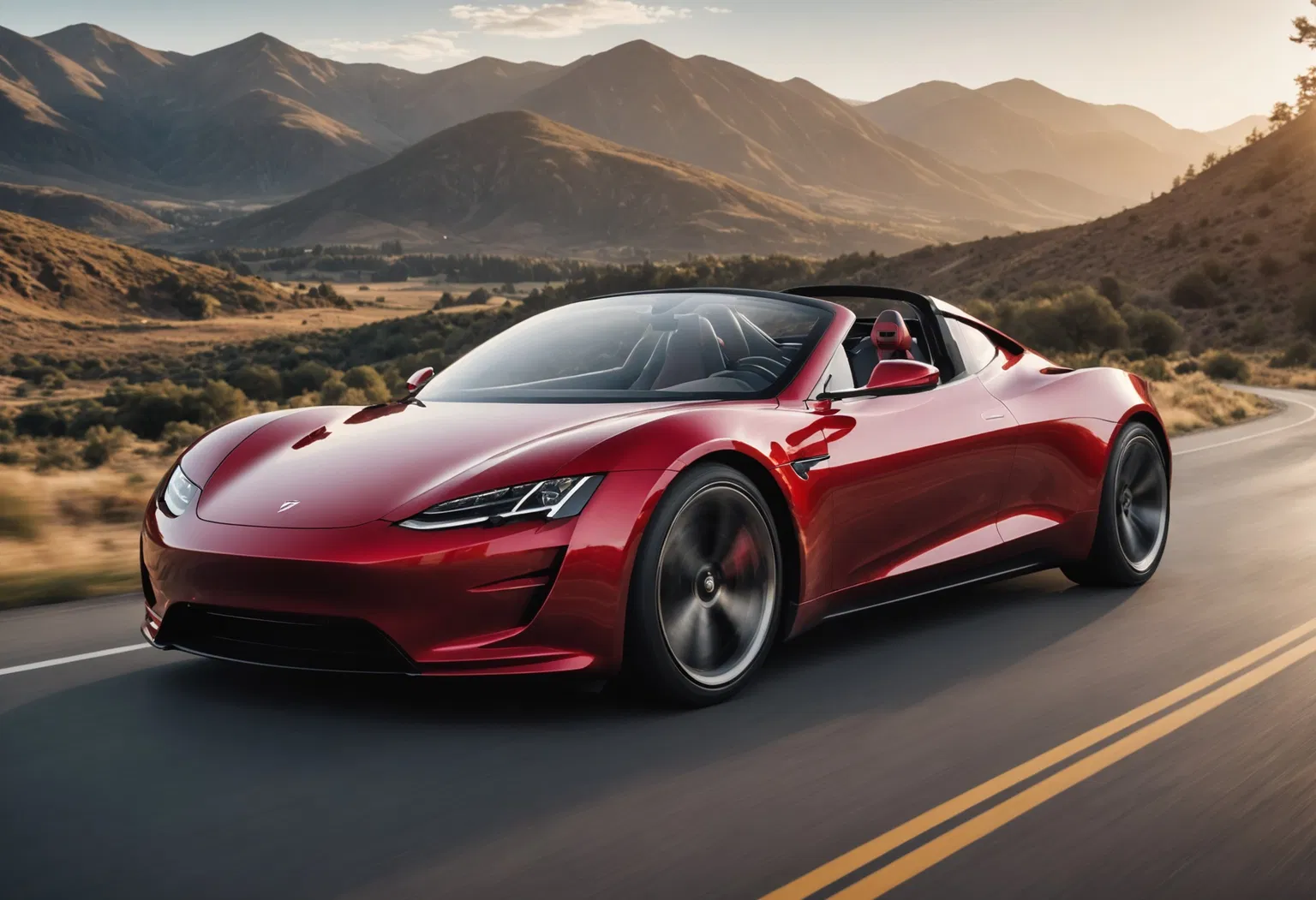
The Tesla Roadster stunned the world on October 15, 2026, when a prototype drove up a curved ramp, clung to the track while fully upside down, launched briefly into the air, and then landed back on its wheels using a burst of compressed-air thrusters. The demonstration looked like movie magic, but every move was built on real, explainable physics: a high-voltage electric drivetrain, a fan-powered suction system that pulls the car toward the ground, and SpaceX-inspired cold-gas thrusters that push it through the air. Here is how the Tesla Roadster actually works, from its battery to its rockets.
The Electric Heart: Battery, Inverter, and Motor
At its core, the Roadster is an all-electric sports car, which means it replaces a gasoline engine with three main building blocks: a large battery pack, an inverter, and electric motors. The battery stores energy as direct current (DC) electricity. When you press the accelerator, that DC power flows to an inverter, which converts it into alternating current (AC). The AC current then spins the electric motors, which turn the wheels directly, with no clutch, no multi-gear gearbox, and no exhaust pipe.
The next-generation Roadster is expected to carry roughly a 200-kilowatt-hour (kWh) battery pack, about twice the energy capacity of the battery in many everyday electric cars. That enormous pack helps explain why Tesla originally claimed a 620-mile range and a top speed above 250 mph when the car was first shown in 2017. Reports from the 2026 reveal point to a total output around 1,340 horsepower and charging that can take the battery from 15% to 85% in about 10 minutes. Electric motors also work in reverse: when the Roadster slows down, regenerative braking turns the motor into a generator, capturing some of that motion energy and feeding it back into the battery.
Cold-Gas Thrusters: Rocket Tech Under the License Plate
The most unusual part of the Roadster is its optional SpaceX package, which swaps the rear seats for a tank of ultra-high-pressure compressed air feeding a set of cold-gas thrusters. A cold-gas thruster is exactly what it sounds like: a small rocket nozzle that releases compressed gas instead of burning fuel. There is no combustion and no flame, only a fast-moving jet of cold gas. The principle is Newton's third law of motion: for every action there is an equal and opposite reaction. As the gas shoots backward out of the nozzle, the car is pushed forward.
The engineering is not new. SpaceX and other space agencies use cold-gas thrusters on spacecraft to make fine adjustments in orbit, where a burning rocket would be too powerful and wasteful. Tesla's version runs on compressed air rather than rocket propellant, which makes it far safer to use near the ground. Reports on the system describe compressing atmospheric air to between 7,000 and 10,000 pounds per square inch (psi) before releasing it. Elon Musk has said the main thruster sits behind the license plate, with additional thrusters positioned around the car. The result is a short, powerful burst of thrust that can sharpen acceleration, help rotate the car in mid-air, and cushion a landing.
The Suction System: How a Car Drives Upside Down
The Roadster's strangest trick, driving upside down, comes from a multi-mode suction system rather than the thrusters. Tesla patents describe electric ducted fans that pull air out from beneath the car's floor and expel it through the rear. Removing that air creates a low-pressure zone under the vehicle, while the normal atmospheric pressure above the car pushes down on it. That downward force, called downforce, presses the car against the road or, in the case of the demo, against the underside of a curved ramp.
This is a modern, electric take on the fan car, a concept made famous by the Brabham BT46 Formula One car in 1978, which used a giant fan to suck itself to the track. The BT46 was so dominant that it was banned after a single race. Tesla's version is fully adjustable: the fans can change speed in milliseconds to maintain suction over bumps and uneven pavement. At a standstill, ordinary wings and spoilers generate no downforce because downforce depends on airflow, but a fan system can create it from zero speed, which is how the Roadster keeps its grip even at low velocity and while inverted.
How the 'Flying' Stunt Actually Works
What looked like flight in the reveal was actually the suction system and the cold-gas thrusters working together. During the October 2026 demonstration at a SpaceX facility in Texas, the car used its suction fans to climb a steep, curved ramp and stay glued to the surface even when it was completely upside down. It then drove off the end of the ramp, and the cold-gas thrusters fired to push and orient the car while it was airborne, before it landed back on its wheels.
It is important to separate a brief, controlled jump from sustained flight. The Roadster's thrusters provide short bursts of force, not the continuous thrust of an aircraft engine, and the suction system needs a surface beneath it to push against. The company describes the technology as enabling a flying-style experience and extreme acceleration rather than everyday aerial commuting. Musk, however, has pointed to a far more ambitious target: a top speed of Mach 0.5, roughly 383 mph, and, in his words, maybe a little higher.
Performance, Trims, and the Road to Production
Tesla says the Roadster will come in three trims: Performance, Thrust, and Rocket. The Performance model is the road-ready base version, the Thrust trim adds the air-thruster hardware, and the top Rocket trim includes the full SpaceX package with the most extreme acceleration. Reservation deposits reported after the reveal range from about $50,000 for the Performance trim up to $250,000 for the Thrust model, with the Rocket version available by invitation only, plus a smaller initial reservation fee of $5,000.
On paper, the numbers are staggering. The base car is claimed to reach 60 mph in under one second, while the Rocket version has been described as reaching 0-60 mph in under 0.59 seconds. During the reveal demonstrations, the prototype clocked 0-60 mph runs around 0.8 seconds. Those figures are possible partly because electric motors deliver maximum torque instantly, and partly because the thrusters add an extra forward push that a conventional car simply does not have.
A Timeline of Delays and Breakthroughs
The Roadster's journey has been long. Tesla first revealed the car in November 2017, promising a 0-60 mph time of 1.9 seconds, a 250-mph top speed, and a 620-mile range, along with a base price of $200,000. The project was then delayed repeatedly while Tesla prioritized the Model 3, Model Y, and Cybertruck. On October 15, 2026, the flying-car demonstration finally gave the Roadster its headline moment. Tesla has said production is now targeted for 2028, and as with any prototype, the final production car may differ, with the most extreme specifications remaining company claims rather than independently verified numbers.
Key Takeaways
- The Roadster is an all-electric sports car with roughly a 200 kWh battery, a claimed 620-mile range, and fast charging that can reach 15-85% in about 10 minutes.
- Its optional SpaceX package replaces the rear seats with a compressed-air tank and cold-gas thrusters that push the car using Newton's third law, with no combustion.
- A fan-based suction system pulls air from beneath the car to create downforce, which is what allows it to drive upside down.
- The flying demo was a controlled jump combining suction for grip and thrusters for airborne maneuvering, not sustained flight.
- Three trims are planned (Performance, Thrust, and Rocket), with production targeted for 2028.