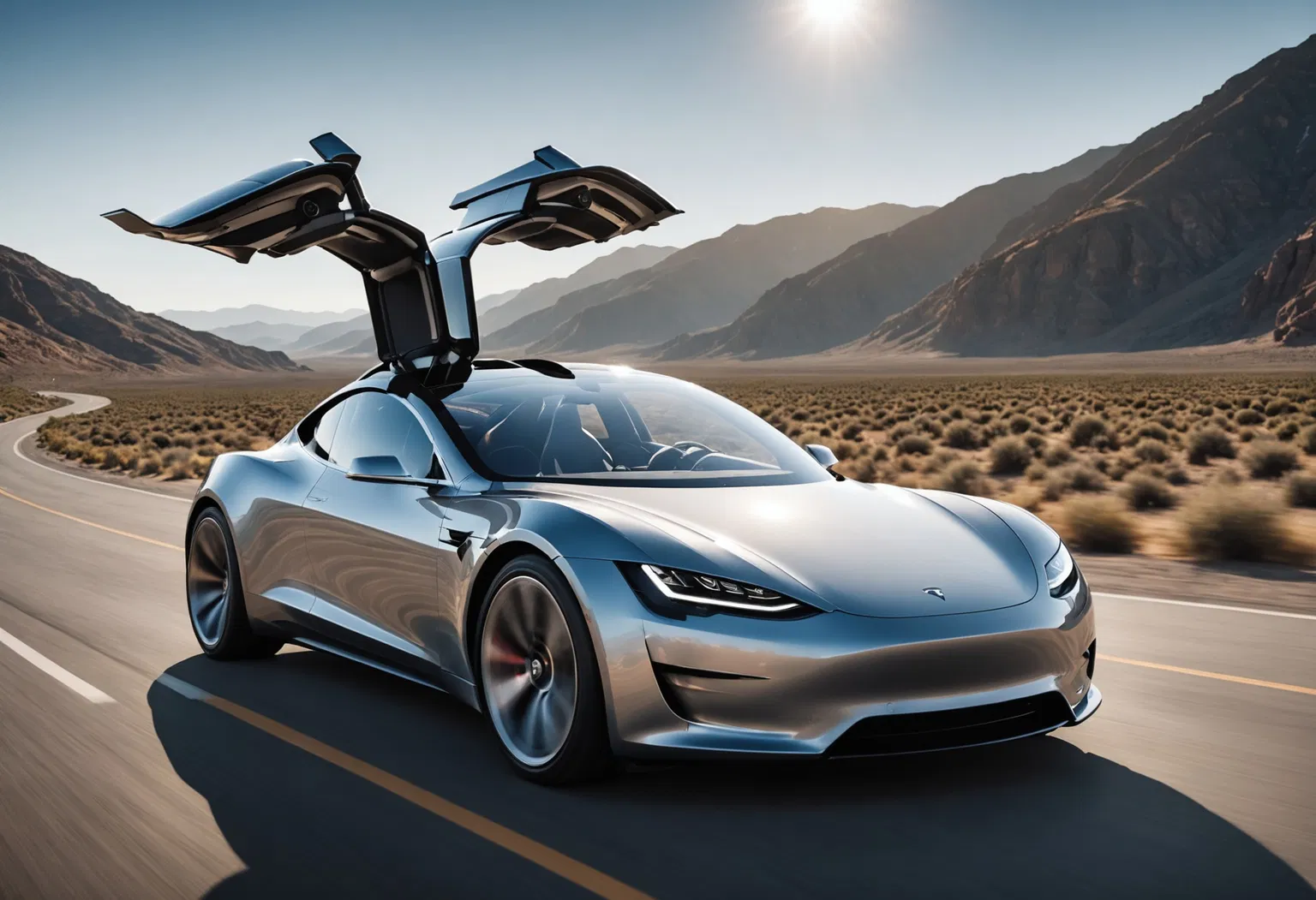
On October 15, 2026, Tesla finally delivered on a promise Elon Musk first made nearly a decade ago — a car that can leave the ground. At a livestreamed event at a SpaceX facility in Texas, the second-generation Tesla Roadster drove up a towering curved ramp, clung to the underside upside down, launched into the air, spun itself around with short bursts of compressed air, and landed back on all four wheels. "Flying cars are real," Musk told the audience. So how does a Tesla flying car actually work? The answer comes down to two systems borrowed from rocket science: cold-gas thrusters that push the car off the ground, and a fan-based suction system that pulls it down.
How the Flying Roadster Works: Cold-Gas Thrusters Explained
The Roadster's ability to fly comes from SpaceX-derived cold-gas thrusters — small rocket engines that expel high-pressure compressed air through nozzles instead of burning fuel. Unlike a traditional rocket, there is no combustion and no flame; the thruster simply releases a jet of pressurized gas, and Newton's third law does the rest. As gas is pushed out of the nozzle in one direction, an equal and opposite force shoves the car in the other. Musk described the setup simply: "The car has obviously altitude control thrusters and main thrusters in the rear, so it can basically fly like a rocket," he said, adding that it can "do rolls" and "crazy gymnastics."
The idea is not new. When Musk first teased the car back in 2018, he posted that a "SpaceX option package" would include about 10 small rocket thrusters arranged around the vehicle. Tesla's final design follows that blueprint, with smaller thrusters placed around the chassis for fine control and larger main thrusters in the rear for forward and upward acceleration. Car and Driver reported that the demonstration vehicle carried roughly 250 kilograms of compressed air to feed the thrusters — enough for the brief bursts of lift shown on stage, but nowhere near enough for sustained flight.
How a Car Drives Upside Down: The Suction Downforce System
The thrusters explain how the Roadster pushes itself upward, but they don't explain one of the demo's most startling moments: the car hanging from the underside of the ramp as if glued to it. That trick comes from a second system — a multi-mode fan and ground-sealing setup that acts as a downforce generator.
Here's how it works. The car's underbody is fitted with fans and a sealed skirt-like floor. When the fans spin up, they pull air out from beneath the vehicle, lowering the air pressure underneath. With normal atmospheric pressure pressing down on top and reduced pressure below, the car is effectively sucked toward whatever surface is beneath it — even if that surface is above it. Tesla says this system produces enough suction to hold the car upside down even while stationary. Unlike a conventional spoiler or wing, which only generates downforce at speed, this fan system works from zero mph, which is why the Roadster could cling to the ramp at a controlled, low-speed pace before launching off the top.
The Physics Limits: Why It's a Hop, Not a Flight
Despite the "flying car" label, the Roadster's flights are measured in seconds, not minutes. A physics breakdown by Scopeviews estimated that hovering a car of this weight would require roughly 28 kilograms of compressed air per second through the thrusters. Compressed-air tanks are heavy and deplete rapidly, so the thrusters can only produce short pulses of lift — enough for a jump, a flip, or a controlled landing, but not for cruising above traffic like a helicopter or airplane.
That reality has drawn skepticism from experts. Some described the demonstration as a "cute demo, but totally impractical," according to Live Science, and tech reviewers questioned whether a 4,000-plus-pound car performing mid-air flips translates into anything useful for real-world transportation. The Roadster is best understood not as an aircraft but as a street-legal-looking sports car that can perform brief, rocket-assisted stunts.
The Legal Gray Zone: What the FAA and Regulators Say
The most immediate barrier to owning a flying Roadster is not physics but law. Asked whether the vehicle counts as an aircraft, the Federal Aviation Administration gave a blunt answer. "The Tesla vehicle does not meet the FAA's definition of an aircraft," FAA spokesperson Rick Breitenfeldt said in a statement reported by Wired and Politico — effectively meaning the agency does not consider the flying Roadster its responsibility to regulate.
That doesn't make it street-legal, though. Tesla's own product page includes a disclaimer that the thruster-equipped version is "not approved for public road use." To drive on public roads, the car would need to meet National Highway Traffic Safety Administration standards, and it remains unclear whether the flying model ever will. In short, the Roadster currently occupies a legal gray zone: not an aircraft in the FAA's eyes, and not a road-legal car either.
From a 2017 Promise to the 2026 Demo: The Roadster's Long Road
The flying Roadster has been a long time coming. Tesla first revealed a prototype of the second-generation Roadster in November 2017, promising deliveries would begin in 2020. In 2018, Musk added the now-famous SpaceX package teaser with its cluster of small rocket thrusters. But the car slipped again and again, and by 2026 it had been nearly nine years since the original reveal.
When the car finally appeared at the October 15, 2026 event, Tesla backed up its most outlandish claims on camera. The Roadster drove up the ramp, flipped through the air using its thrusters, and landed cleanly. Musk's verdict afterward was characteristically understated: "Well, it worked." He also acknowledged the gamble, saying the vehicle's "success is not guaranteed" but that "it will probably work."
A Real Flying Car? Tesla's Roadster vs. eVTOL Aircraft
It's worth distinguishing Tesla's Roadster from the broader "flying car" industry. Companies like Alef Aeronautics are developing true eVTOL (electric vertical take-off and landing) vehicles that use multiple electric motors and propellers to lift off, fly for many miles, and land vertically. Alef's Model A became the first such vehicle to receive a special airworthiness certificate from the FAA in 2023, with a target flight range of about 200 miles.
Tesla's Roadster is a different category of machine. It does not have wings or large rotors for sustained flight. Instead, it performs short, thrust-assisted hops and airborne maneuvers using compressed gas. Think of it less as an airplane and more as a ground vehicle with rocket boosters. That distinction matters when assessing what the technology can and cannot do.
Price, Trims, and What Comes Next
If you want one, Tesla is already taking money. The road-going Roadster Performance trim requires a $50,000 reservation, while the limited "Thrust" edition — which adds the rear thrusters — carries a $250,000 deposit (with $5,000 due up front and the rest within 10 days, according to reservation holders). Reported pricing for the car itself ranges from around $200,000 to $250,000, with high-end configurations reaching roughly $900,000.
Performance numbers are equally extreme. Tesla claims the thruster-equipped car can hit 60 mph in under one second — with some specifications suggesting as little as 0.55 seconds on the top-spec model — and a top speed exceeding 230 mph, powered by a 200 kWh battery pack. Production is reportedly targeted for 2028, though given the car's history of delays, timelines should be taken with a grain of salt.
Key Takeaways
- The Tesla Roadster "flies" using SpaceX cold-gas thrusters that expel compressed air — no combustion, just Newton's third law.
- A fan-and-ground-sealing system creates suction-based downforce that lets the car drive upside down, even at zero speed.
- Flights last only seconds because compressed-air tanks deplete quickly — it's a rocket-assisted hop, not sustained flight.
- The FAA says the car is not an aircraft, and Tesla says the flying model is not approved for public road use.
- Deposits start at $50,000 (Performance) and $250,000 (Thrust), with production tentatively planned for 2028.
- Unlike true eVTOL flying cars such as the Alef Model A, the Roadster performs brief aerial stunts rather than point-to-point flying.