Daylight saving time (DST) is the yearly practice of setting clocks forward by one hour in the spring and back again in the fall, a shift designed to move an hour of morning daylight into the evening. In 2026, that cycle reaches its end on Sunday, November 1, when clocks "fall back" one hour at 2:00 a.m. local time, returning most of the United States to standard time and granting an extra hour of sleep. Knowing exactly when the time changes, why daylight saving time exists, and how the shift affects health and daily life can help you adjust your routine before the switch.
When Does the Time Change in 2026?
In the United States, daylight saving time follows two fixed dates set by the Energy Policy Act of 2005. DST began on Sunday, March 8, 2026, when clocks "sprang forward" from 2:00 a.m. to 3:00 a.m. It will end on Sunday, November 1, 2026, when clocks "fall back" from 2:00 a.m. to 1:00 a.m. local time. The next spring shift is scheduled for Sunday, March 14, 2027.
The change is deliberately scheduled for 2:00 a.m. because most people are asleep at that hour, which minimizes disruption to businesses, transportation schedules, and digital systems. In practice, most modern devices — smartphones, computers, and smart home gadgets — update automatically, while manual clocks, ovens, and some car displays still need a person to adjust them.
How Daylight Saving Time Works
The mechanics are simple and easy to remember with the phrase "spring forward, fall back." In the spring, moving clocks ahead one hour means 2:00 a.m. becomes 3:00 a.m., effectively skipping an hour and "losing" an hour of sleep. In the fall, moving clocks back one hour means 2:00 a.m. becomes 1:00 a.m., repeating the hour and "gaining" an extra hour.
The result is more usable daylight in the evening during spring, summer, and early fall. The official term is "daylight saving time" — singular, not "daylight savings time," a common misnomer. In the United States, the U.S. Department of Transportation oversees time zones and daylight saving time, and only Congress can change the dates or the law governing the practice.
Why Does Daylight Saving Time Exist?
The concept is far older than most people realize. Benjamin Franklin is often credited with the idea thanks to a satirical 1784 essay in which he suggested Parisians could save money on candles by waking earlier to use morning sunlight. Franklin was joking, but the serious proposals came later: New Zealand entomologist George Hudson proposed a two-hour shift in 1895 so he could have more daylight to collect insects after work, and British builder William Willett campaigned for "summer time" beginning in 1907.
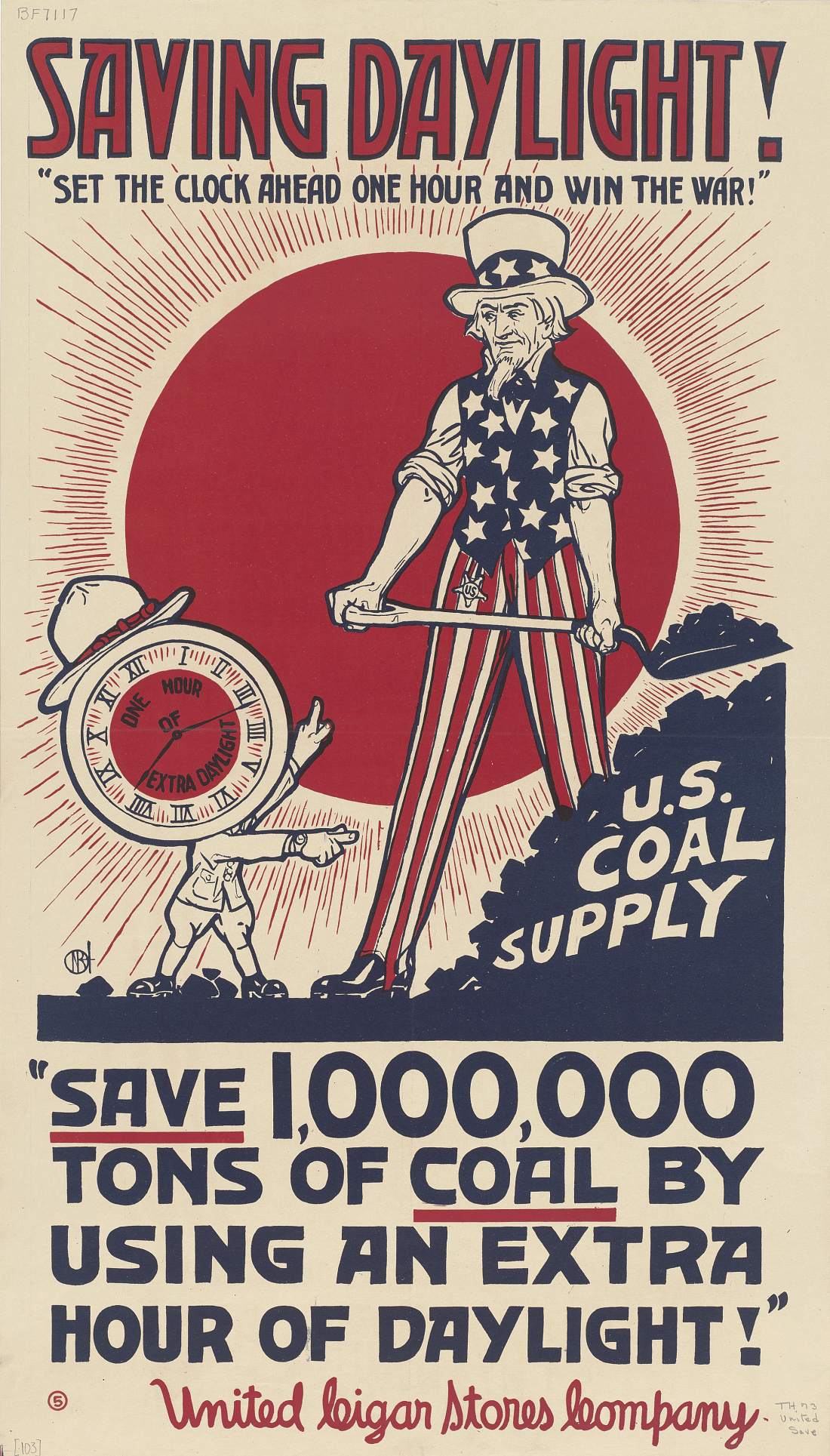
Germany became the first country to adopt daylight saving time on April 30, 1916, during World War I, as a way to conserve coal for the war effort. The United Kingdom and other European nations followed within weeks, and the United States adopted its own version in 1918 through the Standard Time Act. The measure proved unpopular in peacetime, and Congress repealed it in 1919, leaving the choice to local governments for decades.
During World War II, President Franklin D. Roosevelt instituted year-round daylight saving time — called "War Time" — from February 1942 to September 1945. The patchwork of local rules that followed caused confusion until the Uniform Time Act of 1966 standardized the start and end dates nationwide, while allowing states to opt out entirely.
In 1974, amid the oil embargo energy crisis, the U.S. briefly tried permanent daylight saving time. The experiment was quickly reversed after complaints about children going to school in the dark on winter mornings. The most recent change came with the Energy Policy Act of 2005, which, beginning in 2007, extended DST by moving the start from the first Sunday in April to the second Sunday in March, and the end from the last Sunday in October to the first Sunday in November.
One persistent myth is that daylight saving time was created for farmers. In fact, agricultural groups historically opposed the shift, because farm schedules depend on sunrise and livestock habits rather than clock time.
Which States Don't Observe Daylight Saving Time?
Not everywhere in the United States changes the clock. Arizona and Hawaii are the only two states that skip daylight saving time, along with the U.S. territories of American Samoa, Guam, the Northern Mariana Islands, Puerto Rico, and the U.S. Virgin Islands.
Arizona opts out largely because of heat: staying on standard time means the sun sets an hour earlier during the summer, reducing the need for air conditioning in the evening. The Navajo Nation, which spans parts of Arizona, does observe DST to stay consistent across its territory. Hawaii, sitting close to the equator, sees little variation in daylight across the year, so the shift offers little benefit.
Does Daylight Saving Time Still Make Sense?
The twice-yearly switch has become increasingly controversial, and a growing body of research questions whether it is worth the disruption. Studies have linked the spring transition to a measurable rise in health problems. A Michigan study found a 24% increase in heart attacks on the Monday after the spring shift, while research from Finland found an 8% higher rate of ischemic stroke in the first two days after the transition. A 2025 study in JAMA Network Open reported a 13% increase in out-of-hospital cardiac arrests in the days immediately following the change.
The disruption to sleep is well documented, and organizations such as the American Academy of Sleep Medicine argue that permanent standard time — not permanent daylight saving time — is best aligned with the body's natural circadian rhythm. Other studies, including a 2025 Duke University analysis of 170,000 patients, found no significant spike in heart events, suggesting the health picture is still debated.
The energy-saving rationale has also weakened. Modern analyses find that while longer evenings may slightly reduce lighting demand, any savings are often offset by increased heating, cooling, and recreational energy use. Supporters of DST counter that brighter evenings boost retail sales, outdoor recreation, and overall quality of life during warm months.
The policy debate has reached Congress. The Sunshine Protection Act, which would make daylight saving time permanent across the country, passed the U.S. House of Representatives in 2025 and was referred to the Senate on July 15, 2026. As of late October 2026, it has not become law. Nineteen states have passed their own measures signaling they would adopt permanent DST if Congress authorizes it, but under the Uniform Time Act of 1966, states cannot make the switch on their own.
What Happens Next
Change is already underway in parts of North America. British Columbia, Alberta, Manitoba, and the Northwest Territories are skipping the November 1, 2026, clock change and staying on daylight saving time year-round, ending the biannual switch for millions of Canadians. Most of the United States, however, will continue to fall back this November and spring forward again on March 14, 2027, unless Congress acts.
Until then, the simple advice remains the same: set any manual clocks back one hour before bed on Saturday, October 31, and enjoy the extra hour of sleep on Sunday morning.
The Bottom Line: Daylight Saving Time Essentials
- Daylight saving time ends Sunday, November 1, 2026, at 2:00 a.m., when clocks fall back one hour.
- DST began Sunday, March 8, 2026, and returns Sunday, March 14, 2027.
- The shift moves an hour of morning daylight into the evening, following a "spring forward, fall back" pattern.
- The practice began in Germany in 1916 to conserve energy during World War I; the U.S. standardized it with the Uniform Time Act of 1966.
- Arizona (except the Navajo Nation) and Hawaii, along with U.S. territories, do not observe DST.
- Health research links the spring shift to short-term rises in heart attacks, strokes, and cardiac arrests.
- The Sunshine Protection Act to make DST permanent has passed the House but not the Senate as of late 2026.