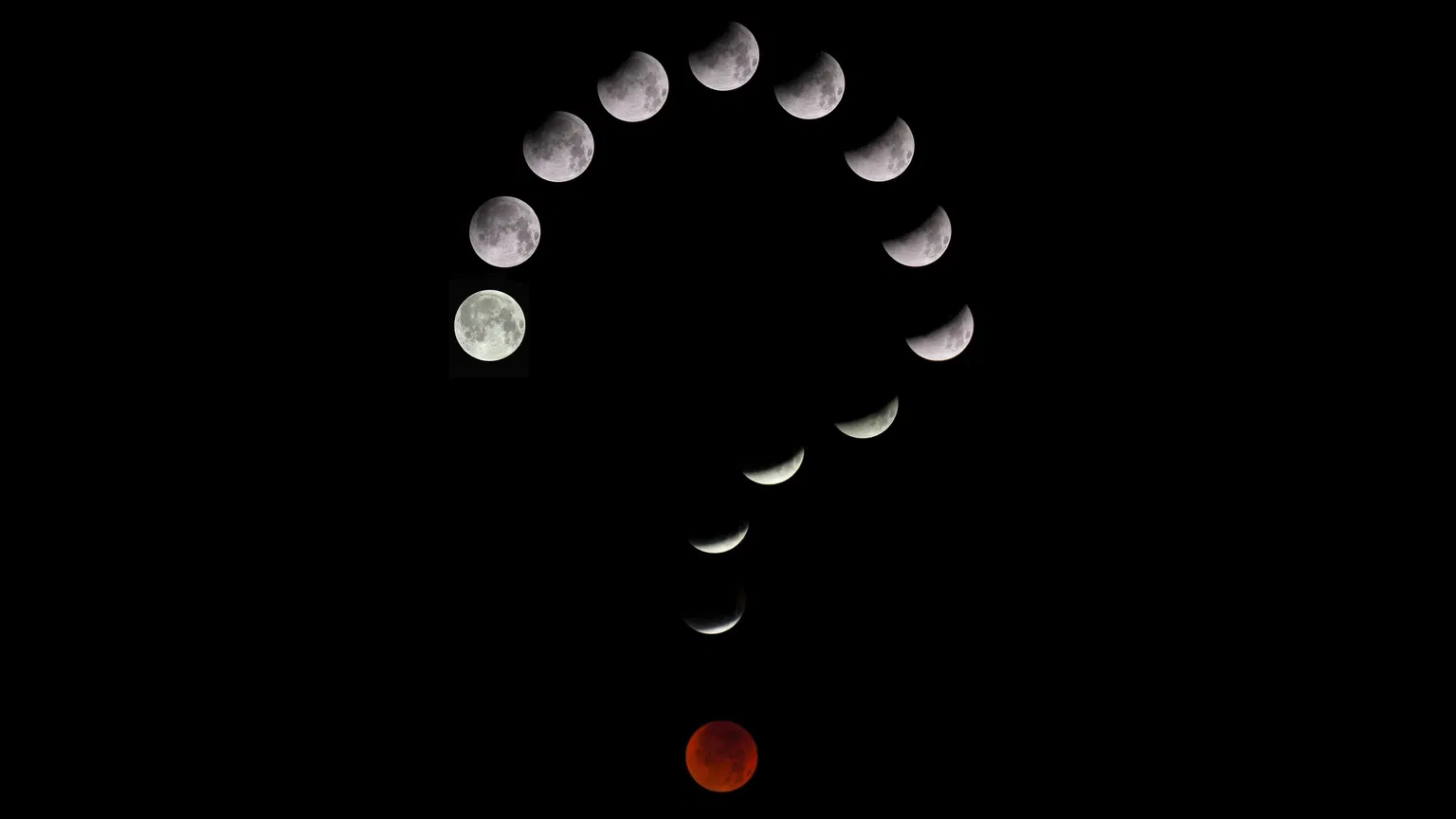
A lunar eclipse is one of the night sky's most dramatic sights: Earth slides directly between the Sun and the Moon, casting its shadow across the lunar surface. Unlike a solar eclipse — which requires protective eyewear and is visible only along a narrow path — a lunar eclipse is completely safe to watch with the naked eye and can be seen by everyone on the night side of Earth at the same time. The partial lunar eclipse of August 27–28, 2026, put that spectacle on display across North America and beyond, and it is a perfect real-world example of the straightforward geometry behind these events. Here is how a lunar eclipse works, why the Moon often glows an eerie red, and how to catch the next one.
How a Lunar Eclipse Works: Earth Casts Its Shadow
A lunar eclipse can only happen during a full moon, when the Moon sits on the opposite side of Earth from the Sun. As NASA explains, during a lunar eclipse Earth's shadow obscures the Moon. When the Sun, Earth, and Moon line up closely enough, the Moon passes through the shadow Earth casts into space.
That shadow has two distinct parts. The dark, cone-shaped inner region is called the umbra, while the wider, lighter outer region is the penumbra. When the Moon moves completely into the umbra, we get a total lunar eclipse. At the Moon's average distance of about 239,000 miles (383,000 km) from Earth, the umbra measures roughly 5,800 miles (9,334 km) across — far wider than the Moon itself, which is only about 2,200 miles (3,540 km) in diameter. That means there is plenty of room for the entire Moon to slip inside Earth's shadow.
How to Watch a Lunar Eclipse Safely
One of the best things about a lunar eclipse is how easy it is to view. You don't need telescopes, filters, or any eye protection — unlike a solar eclipse, a lunar eclipse is completely safe to look at directly. All you need is a clear view of the Moon and some patience.
Find a spot away from bright city lights, let your eyes adjust to the dark, and simply look up. Binoculars or a small telescope can reveal extra detail as the shadow creeps across the lunar surface, but the event is spectacular with the naked eye alone. Because a lunar eclipse unfolds over several hours, you can watch the shadow slowly advance and recede at a relaxed pace.
Key Takeaways: Lunar Eclipse Essentials
A lunar eclipse happens when Earth lines up between the Sun and the Moon, throwing its shadow across the lunar surface. Here are the facts worth remembering:
- Lunar eclipses only occur during a full moon, but not every month, because the Moon's orbit is tilted about 5 degrees relative to Earth's orbit.
- Earth casts two shadows — the dark umbra and the lighter penumbra — that define the type of eclipse.
- A 'blood moon' turns red because Earth's atmosphere scatters blue light and bends red light into its shadow, just like a sunset.
- In the 21st century there are 228 lunar eclipses, averaging about 2.3 per year, and every one of them is safe to watch without eye protection.