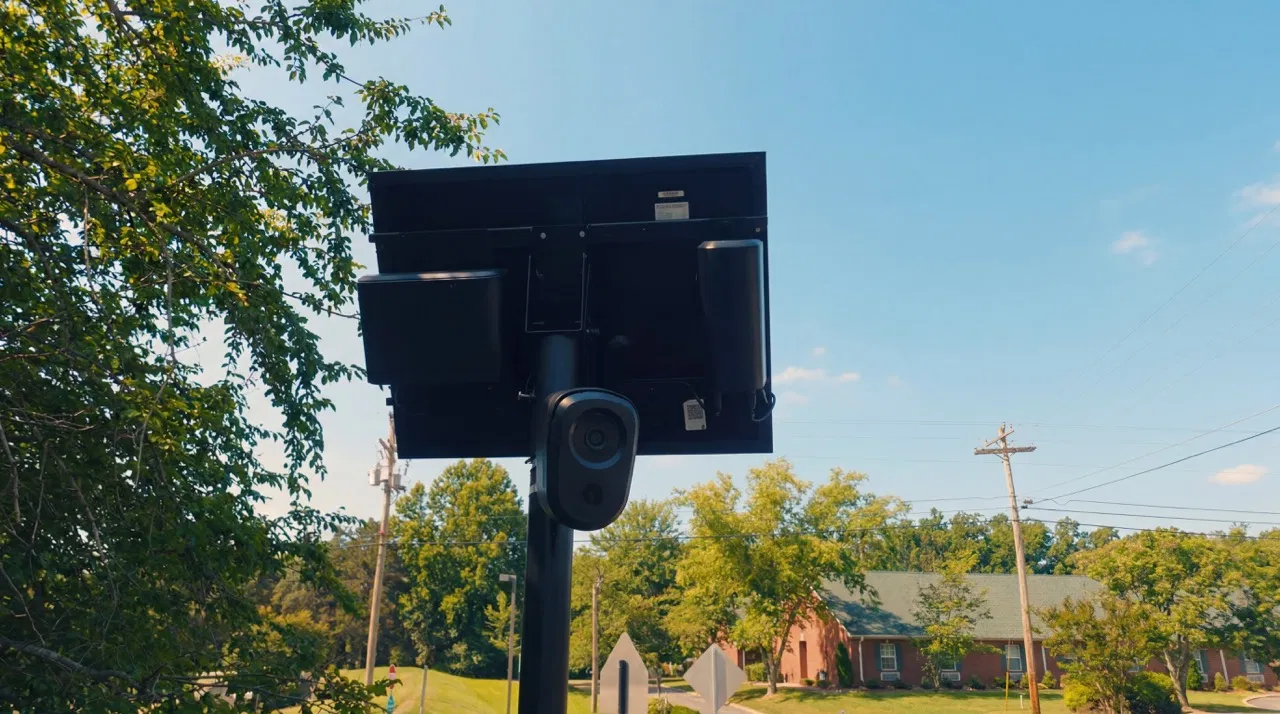
Flock cameras are small, solar-powered automated license plate readers (ALPRs) that photograph every vehicle that passes by, record the license plate, and log the time and location into a searchable national database used by police. Built by Atlanta-based Flock Safety—a company founded in 2017 by three Georgia Tech alumni—these cameras now operate in more than 5,000 communities across 49 U.S. states and scan more than 20 billion vehicles every month, according to the company. That scale has made Flock one of the fastest-growing surveillance networks in the country and, increasingly, a source of legal and political controversy. A free website called Have I Been Flocked (haveibeenflocked.com) now lets anyone check whether their license plate has been searched in the Flock system, drawing on millions of audit logs released through public records requests.
How Flock Cameras Work: The AI Behind the Solar-Powered Boxes
Flock's core products—the Falcon and Sparrow—are pole-mounted cameras that monitor traffic and photograph the rear of every passing vehicle. Software using computer vision reads each license plate and identifies other distinguishing characteristics, then sends that information to Flock's central servers over a cellular network. The servers log every scan with its time and location in a searchable database and automatically compare each plate against the FBI's National Crime Information Center as well as state and local watchlists of stolen vehicles and cars tied to active investigations. When a plate matches, nearby officers are alerted instantly.
The company describes its ability to identify a vehicle's visual details as "vehicle fingerprint technology." Beyond the plate number itself, the system records a car's make, model, and color, along with features such as bumper stickers, dents, mismatched body panels, and temporary tags. That means investigators can search the database not only by plate number but by a vehicle's appearance. Flock says its cameras can photograph vehicles traveling up to 100 mph at distances of up to 75 feet, in any lighting. Because most units are powered by solar panels and rechargeable batteries, they can be placed almost anywhere—on dedicated poles, lampposts, or telephone poles—without a wired power source.
Flock's lineup has expanded well beyond fixed plate readers. Its Condor cameras are pan-tilt-zoom video units that can automatically zoom in on cars, people, and faces. The Raven listens for gunfire. The Alpha is a "drone as first responder" that can read plates from up to 2,000 feet away. In May 2025, reporting revealed a product called Nova, described as a "public safety data platform" that would combine ALPR data with public records and commercially available information to track individuals. Flock maintains that its cameras "focus on vehicles, not people," that it does not use facial recognition, and that captured data is deleted after seven days by default. Critics have challenged those claims: reporting showed Flock's own training videos demonstrating people-tracking, and public records requests revealed police searching for people by race, gender, and clothing.
What "Have I Been Flocked" Means—and How to Check Your Plate
As Flock's network has grown, so has public curiosity about whether any given driver has been caught in it. Have I Been Flocked (haveibeenflocked.com) is a free, independent website—not affiliated with Flock Safety—that lets you type in your license plate to see whether it has been searched in the Flock system. As of the site's latest count, it indexes more than 4.6 million plates across roughly 242 million searches.
The data behind the tool comes from "audit logs" that track searches performed within the Flock system. Some local governments release these logs in response to open records (FOIA) requests, while others publish redacted versions through Flock-provided transparency portals. The site aggregates whatever has been made public, so the dataset is incomplete and often delayed by months or even years—it is not a real-time monitor.
There are two important caveats. First, the results show searches that an operator manually entered into the system—they do not show when or whether your vehicle actually passed one of Flock's estimated 120,000-plus cameras. Second, a search result does not mean you were stopped or investigated; many police agencies do not require a warrant or even reasonable suspicion before running a plate. The site's operators say they do not store, save, or log the plate numbers visitors search for, and the project is funded by donations through a 501(c)(3) fiscal sponsor.
The Privacy Debate: Why Critics Call Flock "Mass Surveillance"
Civil liberties groups argue that Flock's model is fundamentally different from a red-light camera that snaps a single violator. Because these readers photograph every passing car—not just suspects—and because the data is retained and shared across agencies, critics say the system builds a comprehensive record of where ordinary people drive. The ACLU has warned that "there's no reason the technology should be used to create comprehensive records of everybody's comings and goings," adding that in the U.S., "the government should not be tracking us unless it has individualized suspicion that we're engaged in wrongdoing." The Electronic Frontier Foundation has similarly argued that ALPRs create more problems than they solve.
Those concerns have reached the courts. In June 2024, a Norfolk, Virginia judge ruled that collecting location data from the city's 172 Flock cameras constitutes a search under the Fourth Amendment and cannot be used as evidence in a criminal case without a warrant, likening the database to a tracking device. That October, the Institute for Justice filed a federal lawsuit against the Norfolk Police Department over the same practice. In 2025, California reporting found that some law enforcement agencies shared plate data with federal immigration authorities in apparent violation of state law. Several cities—including Los Angeles, whose police department let its Flock contract expire in 2026 citing "serious concerns" over civil liberties and privacy—have pulled back.
Accuracy Problems, Security Flaws, and Officer Misuse
The technology's accuracy has also come under scrutiny. A 2021 analysis by surveillance research firm IPVM found a roughly 10% error rate in the Falcon camera's output. In 2026, Business Insider reported that 71% of the 1,427 stolen-vehicle alerts Flock sent to police in Roseville, California during 2023 and 2024 involved misread plates. Those errors have had real consequences: innocent drivers have been pulled over, detained at gunpoint, and in at least one case jailed for days after a misread. In one 2026 case, a 23-year-old Florida woman was wrongfully arrested and held for 13 days after a Flock camera misidentified her vehicle's color and misread her tag.
Security researchers have also flagged vulnerabilities in the devices, including hardcoded credentials and, in late 2025, a finding that at least 60 Condor cameras were exposed to the open internet, where anyone could view live feeds and archived video. Separately, the Institute for Justice documented dozens of cases of law enforcement officers misusing Flock to stalk romantic partners, exes, and acquaintances—tracking vehicles hundreds of times without a legitimate investigation. The company says misuse and flaws are exceptions, but the pattern has fueled calls for stricter retention limits, audit requirements, and warrant rules.
What Happens Next for Flock Cameras
Flock continues to expand—raising $275 million at a $7.5 billion valuation in March 2025 and acquiring drone maker Aerodome—even as the backlash grows. A planned partnership with Amazon's Ring cameras, announced in October 2025, was scrapped in February 2026 after a Super Bowl ad sparked public outrage. Activists have built tools like Deflock, a crowdsourced map of camera locations, and dozens of jurisdictions have ended or deactivated their contracts.
For drivers, the practical takeaway is simple: if you want to know whether your plate has been searched, you can check Have I Been Flocked for free. If you want more detail about a specific search, you can file a public records request with the police agency that ran it. Privacy advocates also encourage residents to ask their local government how ALPR data is stored, how long it is kept, who can access it, and whether warrants are required—questions that are likely to shape the future of this rapidly spreading technology.
The Bottom Line: Key Points to Remember
- Flock cameras are AI-powered license plate readers that photograph every passing vehicle and log plates in a searchable national database.
- They record more than the plate—make, model, color, bumper stickers, dents, and temporary tags—and can read plates at up to 100 mph.
- Have I Been Flocked (haveibeenflocked.com) is a free, independent tool that shows whether your plate has been searched using public audit logs.
- A search result doesn't mean you were investigated—many agencies don't require a warrant or suspicion to run a plate.
- Privacy groups and some courts argue the system amounts to mass surveillance, and error rates and officer misuse have led to wrongful stops and arrests.