
For the first time in over 50 years, humans are venturing beyond low Earth orbit on a historic journey around the Moon, and thanks to modern technology, anyone with an internet connection can follow along in real time. NASA's Artemis 2 mission, launched on April 1, 2026, represents a critical step toward returning humans to the lunar surface, and the space agency has made unprecedented access available through real-time tracking systems that provide live telemetry, position data, and mission status updates.
The Artemis 2 Mission: What You Need to Know
Artemis 2 is NASA's first crewed test flight of the Orion spacecraft and Space Launch System rocket, marking the beginning of humanity's return to lunar exploration. The mission carries four astronauts on an approximately 10-day journey that includes a lunar flyby before returning to Earth for a splashdown in the Pacific Ocean. Commander Reid Wiseman, pilot Victor Glover, and mission specialists Christina Koch and Jeremy Hansen (the first Canadian to travel beyond low Earth orbit) are testing critical systems that will be essential for future Moon landings.

From Launch to Lunar Flyby: The Artemis 2 Timeline
The mission began with a flawless launch from Kennedy Space Center's Launch Complex 39B on April 1, 2026, at 6:35 p.m. Eastern Time. Over the following days, the Orion spacecraft performed critical maneuvers, including trans-lunar injection that set it on course for the Moon. The highlight occurred on April 6, 2026, when the spacecraft reached its closest approach to the lunar surface, approximately 6,400 miles above the far side of the Moon. During this historic flyby, the crew captured breathtaking images of Earth setting behind the lunar horizon—a perspective not seen by humans since the Apollo era.
How NASA Tracks Space Missions in Real Time
The technology behind Artemis 2 tracking represents a significant advancement from previous space missions. NASA's Deep Space Network—a global system of large radio antennas—provides continuous communication with the Orion spacecraft, receiving telemetry data that includes position, velocity, spacecraft systems status, and crew health metrics. This data is processed through NASA's Artemis Real-time Orbit Website (AROW), which converts raw telemetry into visualizations accessible to the public.
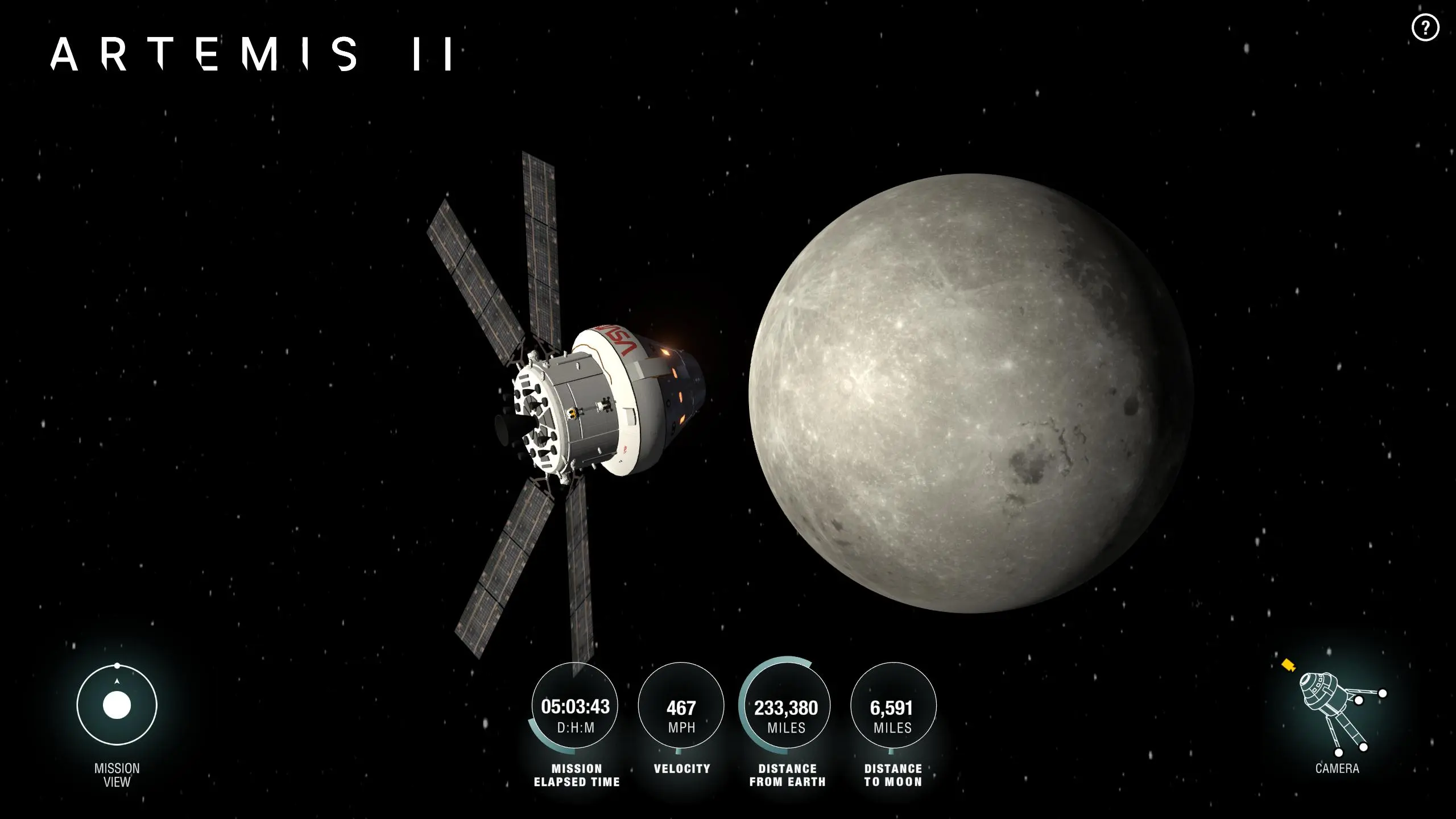
Third-party trackers like ArtemisLiveTracker.com have also emerged, offering enhanced visualizations including 3D trajectory maps, real-time Deep Space Network status panels, and detailed telemetry displays. These platforms use publicly available data from NASA to create immersive tracking experiences that show the spacecraft's current speed (approximately 2,500 mph relative to Earth), distance from Earth and Moon, and precise position along its trajectory.
Where the Mission Stands Now
As of April 8, 2026—Flight Day 8 of the mission—the Artemis 2 crew is cruising back toward Earth, having completed their primary mission objectives. The Orion spacecraft is currently approximately 209,100 miles from Earth and continues to transmit valuable data about spacecraft performance and crew adaptation to the deep space environment. NASA reports all systems are functioning normally, with the crew conducting scientific experiments, testing communication systems, and preparing for their return to Earth.
The Future of Lunar Exploration
The successful execution of Artemis 2 paves the way for Artemis 3, which will land astronauts near the lunar South Pole—potentially as early as 2028. The tracking technology and operational experience gained from this mission will be crucial for future lunar operations, including the planned Lunar Gateway space station and sustained human presence on the Moon. NASA's real-time tracking initiatives also represent a new era of public engagement in space exploration, allowing millions worldwide to participate in humanity's return to the Moon.
Key Takeaways from the Artemis 2 Mission
Artemis 2 demonstrates that NASA's next-generation space transportation system is capable of carrying humans beyond low Earth orbit. The mission has validated Orion's life support systems, radiation protection, and emergency procedures in the deep space environment. Equally important, the public tracking capabilities have created unprecedented transparency and engagement in human spaceflight, inspiring a new generation while providing valuable educational opportunities about orbital mechanics, space technology, and lunar exploration.