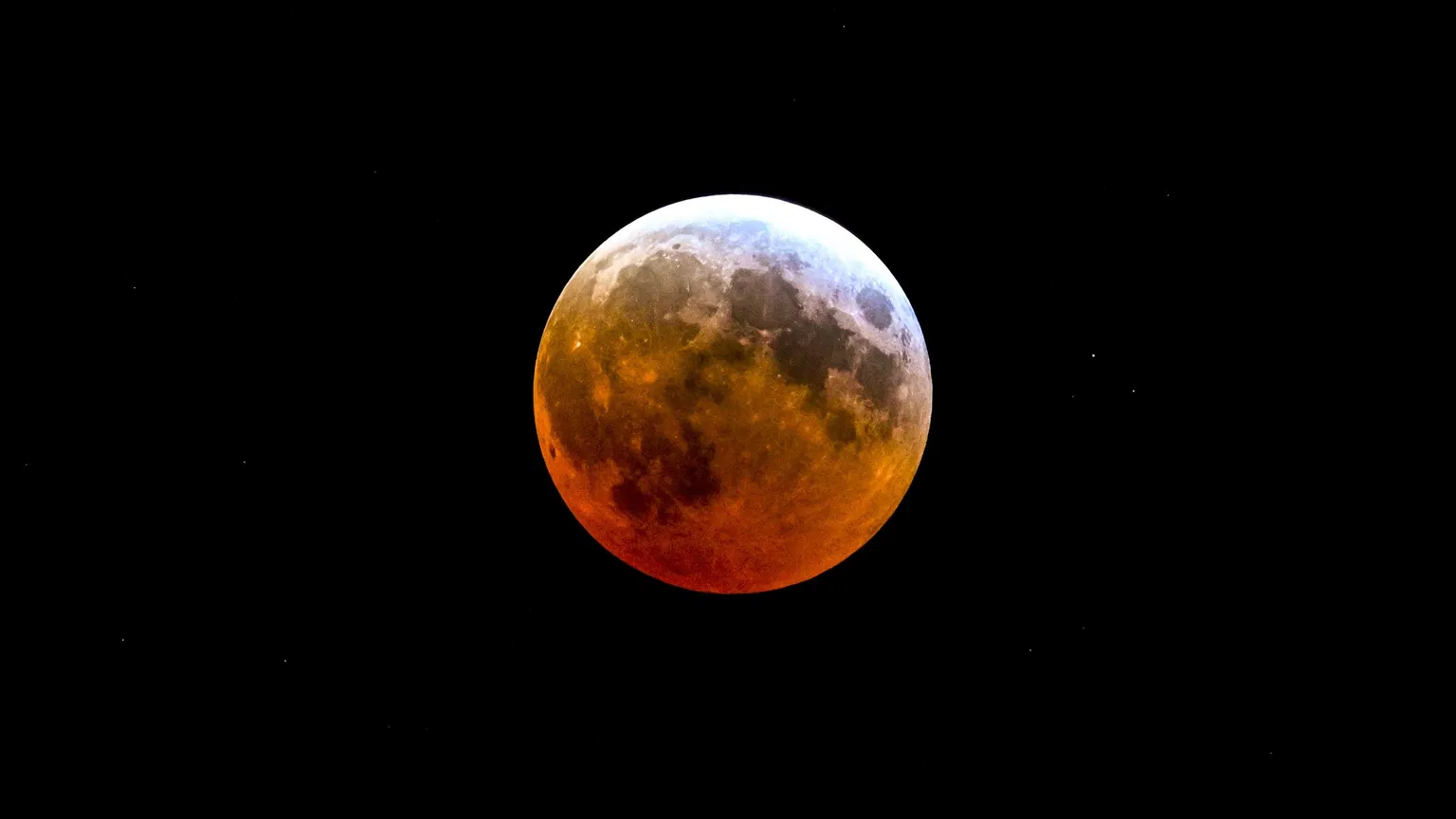
On the night of August 27–28, 2026, the full Moon will slide almost entirely into Earth's dark shadow, creating a deep partial lunar eclipse that will turn up to 96% of the lunar disk a dusky, coppery red. This near-total eclipse is the standout sky event of August 2026, reaching its dramatic peak at 4:13 UTC on August 28. It also closes out an "almost tetrad" of total and near-total lunar eclipses that began in March 2025, making it a fitting finale to several years of remarkable lunar shows.
Because a lunar eclipse is a whole-Earth event, everyone on the night side of our planet watches the very same eclipse at the very same moment — only the numbers on their clocks differ. Here's what a lunar eclipse actually is, when and where to catch August's deep partial eclipse, and how to spot its famous red glow.
A Nearly Total Eclipse: What's Happening on August 28
A lunar eclipse occurs when the Sun, Earth, and Moon line up so that our planet sits directly between the other two, casting its shadow across the Moon. Normally the full Moon shines because it reflects direct sunlight; during a lunar eclipse, that sunlight is blocked as the Moon slips into Earth's shadow.
Earth actually casts two shadows. The outer, lighter shadow is the penumbra, and the inner, darker cone is the umbra. A "penumbral" eclipse — when the Moon only grazes the outer shadow — is so subtle that most people miss it. A "partial" eclipse happens when a section of the Moon enters the umbra, looking like a dark bite taken out of the disk. A "total" eclipse occurs only when the entire Moon is inside the umbra.
August 2026's event sits tantalizingly close to total. At greatest eclipse, 96.3% of the Moon's disk is inside the umbra, which is why astronomers call it a "deep" partial eclipse. Only a thin, bright white sliver — the still-sunlit portion along the Moon's northeastern limb — remains outside the shadow.
Crucially, a lunar eclipse is safe to watch with the naked eye and is visible to everyone on Earth's night side at once — unlike a solar eclipse, which can only be seen from a narrow path.
The Eclipse Timeline: Key Phases to Watch
The August 2026 eclipse unfolds over about five and a half hours, with the partial phase itself lasting roughly three hours and 18 minutes. All times below are given in Universal Time (UTC), with US Central times for reference.
- Penumbral eclipse begins — 1:24 UTC (8:24 p.m. CDT, Aug 27)
- Partial eclipse begins — 2:34 UTC (9:34 p.m. CDT, Aug 27)
- Greatest eclipse — 4:13 UTC (11:13 p.m. CDT, Aug 27)
- Partial eclipse ends — 5:52 UTC (12:52 a.m. CDT, Aug 28)
- Penumbral eclipse ends — 7:02 UTC (2:02 a.m. CDT, Aug 28)
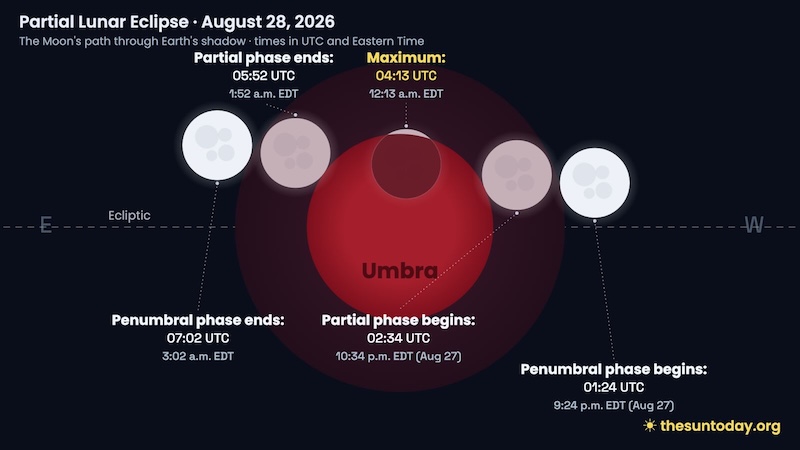
The opening penumbral phase is subtle — many observers won't notice anything at first. The real show begins when the partial phase starts and Earth's dark umbra takes its first visible bite out of the Moon. That darkness then creeps across the lunar face until, at greatest eclipse, only a thin crescent of sunlit Moon remains.
Why the Moon Turns Red: The Science of the 'Blood Moon'
The most famous part of any lunar eclipse is its color. The portion of the Moon inside Earth's umbra doesn't go completely black; instead, it can glow deep red, orange, or copper — the reason lunar eclipses are sometimes nicknamed "blood moons."
That red light is, in effect, every sunrise and sunset on Earth happening at once. Although Earth blocks the Sun's direct rays, our atmosphere bends and filters some sunlight around the planet's edge and toward the Moon. Shorter, bluer wavelengths scatter away, while longer red and orange wavelengths pass through and fall onto the shadowed lunar surface.
Because 96% of the Moon will be inside the umbra at peak, the red glow should be readily visible as the eclipse deepens. Some observers report noticing the color once about 90% of the Moon is shadowed. The darker and clearer your sky, the sooner you'll catch it.
Where and How to See the August 2026 Lunar Eclipse
This eclipse strongly favors the Americas. It will be completely visible across North and South America, seen rising over the central Pacific Ocean and setting over Africa, Europe, and the Middle East. In practice, skywatchers in the United States, Canada, Mexico, and Central and South America sit in the prime zone, while observers in western Europe and western Africa can catch the Moon setting in the pre-dawn sky.
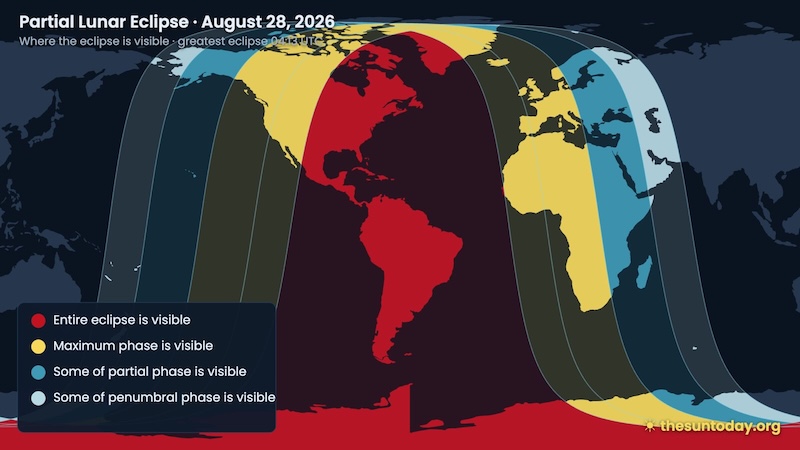
For the UK and Ireland, the eclipse peaks in the early hours of August 28, with maximum at about 5:12 a.m. BST and roughly 93% of the Moon's visible surface inside the darkest part of Earth's shadow. Because the Moon sets at around 6:15 a.m. in London, British observers will see the event cut short by moonset before the partial phase fully ends.
You don't need any special equipment to enjoy the eclipse — it's completely safe to view with the naked eye. Binoculars or a small telescope simply enhance the view. For the best experience, find a spot away from city lights with an unobstructed view, and give your eyes several minutes to adapt to the darkness.
What Comes Next: Future Lunar Eclipses
The August 2026 eclipse belongs to Saros 138, a cycle in which similar eclipses repeat every 18 years, 11 days, and 8 hours. The previous eclipse in this series occurred on August 16, 2008, and the next will arrive on September 7, 2044.
If you miss this one, more lunar eclipses are always on the way — but the next total lunar eclipse, when the entire Moon is immersed in the umbra, won't come until June 2029, when the Moon will pass much deeper into Earth's shadow.
Key Takeaways: The August 2026 Lunar Eclipse at a Glance
- A deep partial lunar eclipse occurs overnight on August 27–28, 2026, peaking at 4:13 UTC on August 28.
- At greatest eclipse, 96.3% of the Moon's disk sits inside Earth's dark umbral shadow — a "nearly total" eclipse.
- The partial phase lasts 3 hours 18 minutes, while the whole event runs about 5 hours 38 minutes.
- It is fully visible across North and South America and visible in parts of Europe and Africa.
- No special equipment is needed — a lunar eclipse is safe to watch with the naked eye.
- It is the last eclipse in an "almost tetrad" that included the March 14, 2025, September 8, 2025, and March 3, 2026 total lunar eclipses.