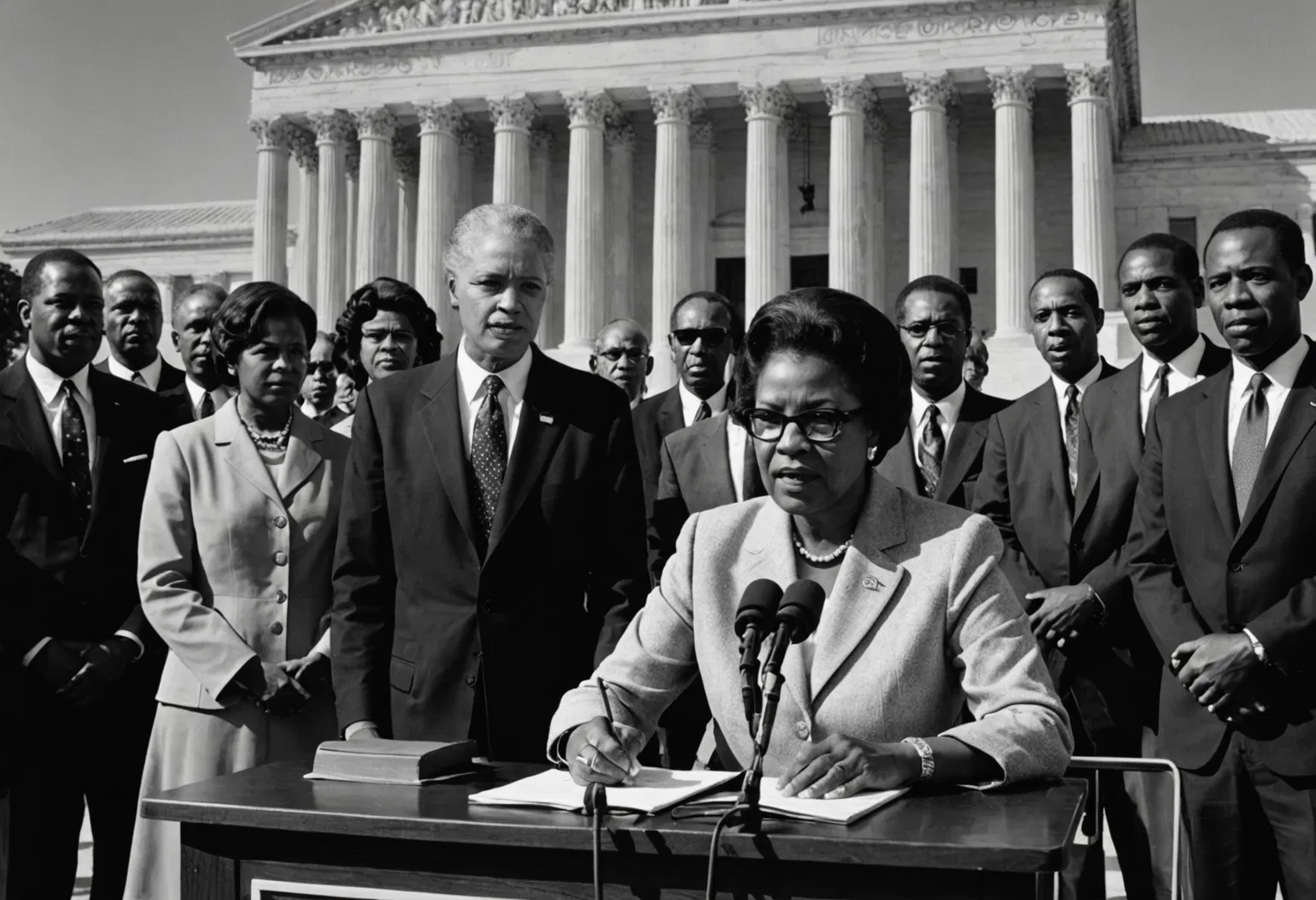
The Voting Rights Act of 1965 stands as one of the most consequential civil rights laws in American history — a federal statute designed to eliminate racial discrimination in voting and enforce the 15th Amendment's guarantee that no American shall be denied the right to vote based on race. For six decades, it served as the backbone of federal voting protections, but two landmark Supreme Court decisions — in 2013 and most recently in April 2026 — have dramatically weakened its power. Here is how the Voting Rights Act works, what it originally did, and what the latest ruling means.
What Is the Voting Rights Act and Why Was It Created?
The Voting Rights Act (VRA) was signed into law by President Lyndon B. Johnson on August 6, 1965, at the height of the civil rights movement. Despite the 15th Amendment's ratification in 1870, Southern states had spent decades erecting barriers to Black voting through poll taxes, literacy tests, grandfather clauses, and outright intimidation. In Selma, Alabama, for example, half the population was Black in 1965, but only 2% of the county's 15,000 eligible Black voters were registered to vote.
The tipping point came on March 7, 1965 — "Bloody Sunday" — when Alabama state troopers attacked hundreds of peaceful voting rights marchers on the Edmund Pettus Bridge in Selma. The nationally televised violence galvanized public opinion, and President Johnson pushed Congress to act. The VRA passed with overwhelming bipartisan support: 77-19 in the Senate and 333-85 in the House.
Key Provisions: How the VRA Worked
The VRA had two main pillars. The first was a general prohibition on racial discrimination in voting, now codified as Section 2. The second was a set of special provisions — most notably Section 5's preclearance requirement — that applied only to jurisdictions with a history of discriminatory voting practices.
Section 2: The General Ban on Discriminatory Voting Practices
Section 2 prohibits any voting practice or procedure that discriminates on the basis of race, color, or language-minority status. Crucially, when Congress amended Section 2 in 1982, it specified that plaintiffs do not need to prove intentional discrimination — only that the practice has a discriminatory effect. This "results test" made Section 2 an extremely effective tool for challenging racially gerrymandered maps, at-large election systems, and other tactics that diluted minority voting power.
The results were dramatic. While only 18 Black representatives served in the 96th Congress (1979-1981), the 119th Congress (2025-2027) included 65 Black representatives and 5 Black senators. Nationwide, the number of Black elected officials surged from 1,469 in 1970 to more than 10,000 today.
Section 5 and the Preclearance System
Section 5 required states and localities with the worst histories of discrimination — mostly in the Deep South — to "preclear" any new voting laws or redistricting plans with the federal government before they could take effect. A jurisdiction had to prove that the proposed change would not make minority voters worse off. This "coverage formula" in Section 4 determined which jurisdictions were covered. Congress reauthorized the VRA four times (in 1970, 1975, 1982, and 2006), each time with overwhelming bipartisan majorities.
Timeline: How the Supreme Court Dismantled the VRA
- June 25, 2013 — Shelby County v. Holder: In a 5-4 decision, the Supreme Court struck down Section 4's coverage formula, effectively gutting the preclearance system. Chief Justice John Roberts wrote that "things have changed dramatically" since 1965. Justice Ruth Bader Ginsburg famously dissented: "Throwing out preclearance when it has worked and is continuing to work to stop discriminatory changes is like throwing away your umbrella in a rainstorm because you are not getting wet."
- 2013-2026 — The Aftermath: Without preclearance, states formerly covered by Section 5 passed new voting restrictions — voter ID laws, polling place closures, and voter purges. The racial turnout gap between white and nonwhite voters reached 18 percentage points by the 2022 midterms, growing twice as quickly in formerly covered counties.
- April 29, 2026 — Louisiana v. Callais: The Supreme Court delivered its second major blow to the VRA, this time targeting Section 2. The 6-3 ruling held that Louisiana's congressional map, which created a second majority-Black district to comply with Section 2, was an unconstitutional racial gerrymander.
What Happened in Louisiana v. Callais?
Louisiana's 2020 congressional map had only one district — out of six — where Black voters (who make up one-third of the state's population) had a realistic chance of electing a candidate. Black voters sued under Section 2, and a federal court ordered the state to create a second majority-Black district. Louisiana complied in early 2024, and in the 2024 elections, two Black Louisianians were elected to Congress for the first time in the state's history.
Then a group of self-described "non-Black" voters challenged the map as an unconstitutional racial gerrymander. The Supreme Court's conservative majority agreed, imposing new requirements that fundamentally altered Section 2. Under the new standard, voters challenging a discriminatory map must now prove that the state acted with racially discriminatory intent — not just discriminatory effect — and the ruling allows states to defend discriminatory maps simply by claiming they were based on partisan politics instead of race.
Justice Elena Kagan, joined in dissent by Justices Sonia Sotomayor and Ketanji Brown Jackson, wrote that the decision "threatens a half-century's worth of gains in voting equality" and warned that requiring proof of intentional discrimination "renders Section 2 all but a dead letter." She concluded: "[The VRA] ushered in awe-inspiring change, bringing this Nation closer to fulfilling the ideals of democracy and racial equality. And it has been repeatedly, and overwhelmingly, reauthorized by the people's representatives in Congress. Only they have the right to say it is no longer needed — not the Members of this Court."
Where Things Stand Now
The immediate consequences of the Callais ruling are unfolding rapidly. Louisiana Governor Jeff Landry (R) indicated he plans to suspend the state's May 16 primary elections so lawmakers can pass a new congressional map. Republicans in several other states, including Florida, have pointed to the ruling as justification for redrawing their own congressional maps. The ruling is expected to modestly improve Republican electoral prospects heading into the 2026 midterm elections.
Beyond the immediate electoral impact, the decision fundamentally alters the legal landscape. Campaign Legal Center described it as "one of the most consequential setbacks for our multiracial democracy in a generation." Going forward, voters will face significantly higher evidentiary hurdles to challenge racially discriminatory maps, and states have a clear roadmap to draw voting districts that dilute minority voting power — as long as they cite partisan motivations.
What Happens Next for Voting Rights
The fight to protect voting rights now shifts primarily to Congress and state legislatures. Advocates are calling on Congress to pass new federal voting rights legislation that would restore the protections the Supreme Court has stripped away — including the John Lewis Voting Rights Advancement Act, which would update the preclearance formula. At the state level, several states have begun adopting their own State Voting Rights Acts to provide protections independent of federal law. The Campaign Legal Center and other pro-democracy organizations continue to litigate and advocate for policy solutions. But as Justice Kagan's dissent underscored, the responsibility ultimately rests with the American people and their elected representatives to decide whether the protections of the Voting Rights Act remain essential — or whether the Court has written the final chapter of one of the nation's most successful civil rights laws.
Key Takeaways
- The Voting Rights Act of 1965 banned racial discrimination in voting and required certain states to preclear voting changes with the federal government.
- Section 2, which prohibited voting practices with discriminatory effects, was the law's primary remaining enforcement tool after Shelby County v. Holder (2013) gutted the preclearance system.
- The Supreme Court's April 2026 ruling in Louisiana v. Callais fundamentally weakened Section 2 by requiring proof of intentional discrimination and allowing a partisan-gerrymandering defense.
- More than 10,000 Black elected officials serve nationwide today — a direct result of the VRA's protections, now at risk.
- Congress and state legislatures are now the primary battlegrounds for restoring voting rights protections.