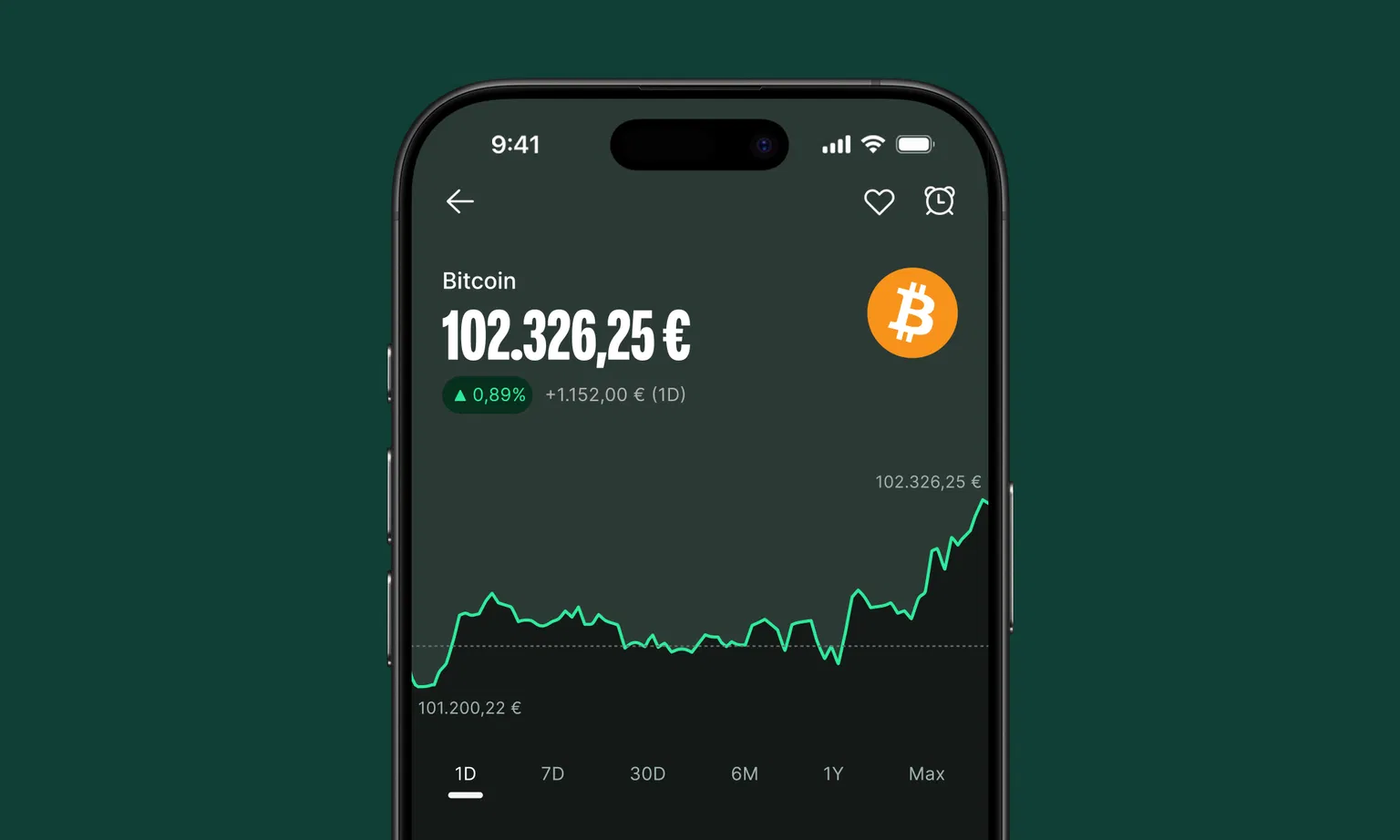
If you have ever watched a bitcoin price chart, you know it rarely sits still. One day the cryptocurrency climbs 5%, only to give back 10% the next. But unlike the US dollar or the euro, whose value is managed by central banks, the bitcoin price is not set by any single authority. It emerges from the constant interplay of supply and demand across a worldwide network of exchanges, investors, and traders. In this guide, we explain exactly how bitcoin's price works, what pushes it up and down, and why it is so volatile.
How Bitcoin's Price Is Actually Determined
The first thing to understand about the bitcoin price is that there is no central bank, government, or company behind the scenes deciding what it should be worth. Unlike fiat currencies such as the US dollar or the euro, which are influenced by monetary policy, bitcoin's value is set purely by the market. In simple terms, the price you see is the last agreed-upon trade between a buyer and a seller on an exchange.
Behind that number sits the basic economic principle of supply and demand. When more people want to buy bitcoin than sell it, the price rises. When more people want to sell than buy, the price falls. On crypto exchanges, automated order books continuously match buyers and sellers, and each completed trade updates the live price. Because bitcoin trades on many different platforms around the clock, its price is always in motion — there is no market close and no opening bell.
Bitcoin is also the largest cryptocurrency by market capitalisation, meaning it is listed on virtually every major trading venue. That broad availability increases its visibility and supports demand, but it also means that news, sentiment, and large trades can ripple across the entire market within seconds.
From Zero to Six Figures: How Bitcoin's Price Evolved
Bitcoin did not start out with a meaningful price at all. The network launched in January 2009, when its pseudonymous creator, Satoshi Nakamoto, mined the first block, and for a long time the coins had essentially no market value. The famous early benchmark came in May 2010, when a programmer paid roughly 10,000 BTC for two pizzas — a purchase now worth hundreds of millions of dollars at later prices.
Several milestones have shaped the bitcoin price since then:
- 2013: Bitcoin's first major run drew mainstream attention, but the collapse of the Mt. Gox exchange — then handling about 70% of all bitcoin transactions — triggered a sharp decline of nearly two-thirds after more than 650,000 BTC were lost.
- 2017: A wave of retail speculation pushed the price to nearly $20,000 before a long bear market followed.
- 2021: Bitcoin reached an all-time high near $69,000 amid rising institutional interest, before China's ban on crypto transactions sent prices tumbling.
- 2024: The approval and launch of spot Bitcoin ETFs in the United States gave traditional investors a simpler way to gain exposure, helping drive the price to a fresh record.
Running through this timeline are the halving events, which occur roughly every four years. Each halving cuts the reward miners receive for adding new blocks, slowing the release of new coins into circulation and reinforcing bitcoin's scarcity.
10 Key Factors That Move the Bitcoin Price
Supply and demand are the headline explanation, but many underlying forces shape them. Here are the factors that most influence the bitcoin price.

1. Market and trading venues. For bitcoin to hold long-term value, it needs functioning platforms where people can buy and sell. The more exchanges that list BTC, the more potential buyers are reached, and trust grows.
2. Hype and FOMO. Media reports, social media posts, and prominent supporters can fuel sharp short-term moves. In 2021, for example, Elon Musk announced Tesla would accept Dogecoin for merchandise, and that token's price jumped more than 20% almost immediately. Bitcoin is subject to the same kind of hype cycles.
3. Exchange and platform events. Major news involving crypto service providers cuts both ways. The 2024 US spot ETF approvals sent bitcoin surging, while the 2013 Mt. Gox bankruptcy triggered a collapse of nearly two-thirds.
4. Community. Over the long run, the strength of a coin's community matters. In 2016, when prominent developer Mike Hearn declared the "Bitcoin experiment" had failed, the price dropped about 10% in response.
5. Supply and the 21 million cap. Satoshi Nakamoto set a hard limit of 21 million bitcoins. Roughly every four years, the mining reward is halved, gradually slowing new supply. When supply growth slows and demand holds or rises, prices tend to move up.
6. Technology and forks. Bitcoin runs on a blockchain that keeps evolving. When the network splits into competing versions — a "hard fork" or "soft fork" — uncertainty can make investors cautious and increase volatility.
7. Competition. Thousands of alternative cryptocurrencies compete for attention, many trying to solve bitcoin's limitations around scalability, energy use, and security. If rivals gain an edge, they can put downward pressure on BTC.
8. Fiat currencies and inflation. When inflation rises and a currency like the US dollar loses purchasing power, some investors turn to bitcoin as a store of value — the "digital gold" narrative — which can boost demand.
9. The legal environment. Regulation is a double-edged sword. China's 2021 ban caused a sharp sell-off, while clearer frameworks — such as Germany's 2025 crypto tax rules or Vietnam's 2025 law recognising digital assets — can build trust and attract institutions.
10. Politics and the economy. Global crises, elections, and macroeconomic shifts all influence whether investors move money into or out of crypto, directly affecting the bitcoin price.
Why Bitcoin's Price Swings So Much
Compared with stocks, bonds, or gold, bitcoin is extremely volatile — its price can change by large percentages in a single day. There are a few reasons for this. The overall crypto market is still young and relatively lightly regulated, many participants are willing to take big risks, and speculation is high. Because of bitcoin's fixed supply cap, demand plays an outsized role: when buyers rush in, prices can spike quickly, and when sellers panic, prices can fall just as fast.
The truth is that no one can perfectly predict why the bitcoin price moves on any given day. Political events, technical issues, and even a single social media post can all be enough to shift sentiment and move the market.
What Could Shape Bitcoin's Price Next
Looking ahead, several forces will likely define the bitcoin price. Regulation remains one of the biggest — while global progress is uneven, clearer legal frameworks could make bitcoin more attractive to mainstream and institutional investors. Growing acceptance, both by companies that accept bitcoin payments and by firms such as MicroStrategy that hold it on their balance sheets, could also support demand.
At the same time, risks remain. A major economy banning cryptocurrencies, technical problems such as contentious forks, or a sudden collapse in hype could all push the price down sharply. The next halving cycle, expected around 2028, is also likely to be a focal point, since each halving increases scarcity and has historically coincided with renewed attention on bitcoin's price.
Key Takeaways: How the Bitcoin Price Works
- The bitcoin price is determined by supply and demand, not by any central bank or government.
- Bitcoin's supply is capped at 21 million coins, and mining rewards halve roughly every four years.
- Regulation, institutional adoption, hype, halving cycles, macroeconomics, and exchange events all influence the price.
- Bitcoin is a speculative and highly volatile asset, so its price can swing dramatically in a short time.
- The final bitcoin is not expected to be mined until around the year 2140, meaning scarcity will keep increasing over time.