
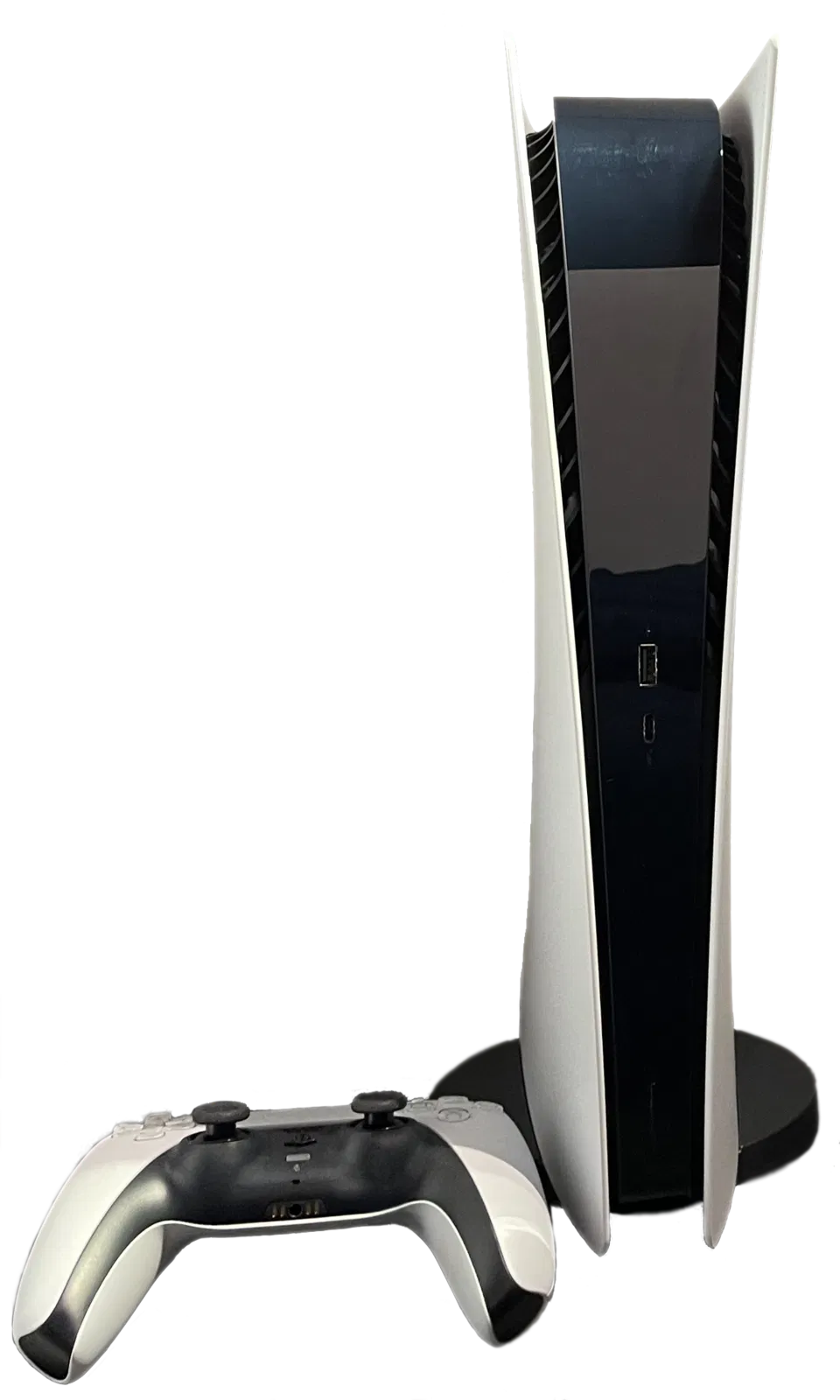
The PlayStation 5, better known as the PS5, is a home video game console designed and sold by Sony Interactive Entertainment. It is the fifth main console in the PlayStation series and the direct successor to the PlayStation 4. Sony released the PS5 on November 12, 2020, in the United States, Japan, Canada, Mexico, Australia, New Zealand, and South Korea, followed by a global launch on November 19, 2020. At launch, the standard console with a 4K Ultra HD Blu-ray disc drive cost $499, while the disc-less Digital Edition sold for $399. Since then, the console has become one of the fastest-selling game systems in history, with more than 84 million units sold worldwide.
The PS5 marked a major leap from the previous generation. Its defining feature is a custom solid-state drive (SSD) that slashes loading times from nearly a minute to just a few seconds, alongside a new DualSense controller that delivers haptic feedback and adaptive triggers for a more tactile gaming experience. In this guide, we explain exactly what the PS5 is, how its hardware works, how to set it up, and how it compares with rivals such as the Xbox Series X.
What Exactly Is the PlayStation 5?
The PS5 is a ninth-generation console that competes directly with Microsoft's Xbox Series X and Series S and, to a lesser extent, the Nintendo Switch. It builds on a lineage that began with the original PlayStation in 1994. Unlike a PC, a console like the PS5 is a fixed, standardized piece of hardware: every PS5 has the same processor, graphics chip, and storage, which lets developers optimize games precisely for that machine.
Three main hardware versions of the PS5 now exist. The original model launched in November 2020 in two forms — a standard edition with a disc drive and a Digital Edition without one. In November 2023, Sony introduced a slimmer redesign (often called the PS5 Slim) with a detachable disc drive, and in November 2024 it released the more powerful PS5 Pro, aimed at players who want higher frame rates and sharper visuals.
Inside the PS5: How the Hardware Works
At the heart of the PS5 is a single custom chip built with AMD that combines the central processing unit (CPU) and graphics processing unit (GPU). The CPU uses eight Zen 2 cores with 16 threads running at a variable clock speed up to 3.5 GHz — the "brains" that handle game logic, physics, and artificial intelligence. The GPU is based on AMD's RDNA 2 architecture with 36 compute units and roughly 10.28 teraflops of floating-point performance, and it supports hardware-accelerated ray tracing for realistic lighting and reflections. A teraflop is a measure of how many trillion calculations the graphics processor can perform each second.
The console pairs that silicon with 16 GB of GDDR6 memory and, most importantly, a custom 825 GB SSD. The SSD can read data at around 5.5 GB per second in its raw form — roughly 100 times faster than the mechanical hard drive in the PS4. That speed is why PS5 games load in seconds, why open-world games can "fast travel" almost instantly, and why textures and detail stream in without the pop-in that older consoles suffered from. The PS5 also includes a Tempest 3D AudioTech engine that creates spatial, three-dimensional sound through ordinary headphones or TV speakers, and it can output video at up to 4K resolution at 120 frames per second (and technically up to 8K). If the 667 GB of usable storage fills up, owners can add a compatible M.2 NVMe SSD in the internal expansion slot.
The DualSense Controller: Haptic Feedback and Adaptive Triggers Explained
The DualSense wireless controller is one of the PS5's most talked-about innovations, replacing the PS4's DualShock 4. Two features set it apart. First, haptic feedback replaces the old spinning "rumble" motors with precise voice-coil actuators, so the controller can produce a wide range of subtle vibrations — the crunch of gravel under a car's tires, the patter of rain, or the twang of a bowstring — instead of one generic buzz. Second, adaptive triggers in the L2 and R2 buttons can change their resistance on the fly, so pulling a bow feels stiff, while a trigger on a jammed weapon can suddenly lock up.

The DualSense also includes a built-in microphone, a touchpad, motion sensors, and a "Create" button that replaced the old Share button for capturing screenshots and video clips. Together, these features give developers new ways to communicate the feel of a game world directly through the player's hands.
How to Set Up Your PS5 Step by Step
Setting up a PS5 is straightforward. Start by placing the console on a stable surface (horizontally or vertically) and connecting the included HDMI cable from the console to your television. Plug in the power cable, then press the power button on the front of the console.
Next, connect the DualSense controller to the console using the included USB-C cable on first use, then press the PlayStation button. Follow the on-screen prompts to select your language, connect to Wi-Fi or a wired Ethernet network, and either sign in to an existing PlayStation Network account or create a new one. The system will then check for and install the latest system software update — an important step, since updates add features and security fixes. If you are upgrading from a PS4, you can transfer saved data, games, and settings during setup. Finally, insert a game disc (on disc models) or download games from the PlayStation Store and you are ready to play.
PS5 vs. Xbox Series X: The Key Differences Explained
Microsoft's Xbox Series X is the PS5's most direct rival, and the two machines are closely matched on paper. The Series X has a slightly more powerful GPU, rated at 12 teraflops versus the PS5's 10.28, and it includes a 1 TB SSD. However, the PS5's SSD is roughly twice as fast in raw throughput (about 5.5 GB/s versus 2.4 GB/s), which helps compensate and often translates to quicker load times. Both consoles use eight-core AMD Zen 2 CPUs and 16 GB of GDDR6 memory, and both launched in November 2020 at $499 for the disc-equipped models.
The biggest differences come down to games and services. Sony leans on exclusive franchises such as God of War, Marvel's Spider-Man, Horizon, and The Last of Us, plus the PS Plus subscription service. Microsoft emphasizes Xbox Game Pass, a Netflix-style library available across Xbox consoles, PC, and cloud streaming. The choice between them is usually less about raw numbers and more about which exclusive games and ecosystem a player prefers.
Backward Compatibility, Games, and GTA 6
One of the PS5's most practical strengths is backward compatibility: it plays the overwhelming majority of PS4 games, often with better performance through a feature called Game Boost, which can raise frame rates and improve loading times. This means new PS5 owners bring a large existing library of PS4 titles with them.
Looking ahead, Rockstar Games has confirmed that Grand Theft Auto VI — arguably the most anticipated game of the decade — will launch on November 19, 2026, for PS5 and Xbox Series X|S, including the PS5 Pro. GTA 6 is expected to be a major driver of PS5 sales, much as GTA V boosted the PS3 and PS4 before it.
The PS5 Slim and PS5 Pro: Newer Models Explained
Sony has refreshed the PS5 line twice. The PS5 Slim (2023) is smaller and lighter than the original and swaps the integrated disc drive for a detachable Ultra HD Blu-ray drive that can be purchased separately for the Digital Edition. The PS5 Pro (launched November 7, 2024, at $699.99) targets enthusiasts: it has a GPU with about 67% more compute units, 2 TB of storage, and a new technology called PlayStation Spectral Super Resolution (PSSR). PSSR uses machine-learning hardware to upscale a lower-resolution image to a sharper 4K output, letting games hit higher frame rates without sacrificing visual detail.
The Bottom Line: PS5 Key Takeaways
- The PS5 is Sony's fifth home console, launched November 12–19, 2020, starting at $399 (Digital) and $499 (disc).
- It runs on a custom AMD Zen 2 CPU, an RDNA 2 GPU (10.28 teraflops), 16 GB of GDDR6 memory, and an 825 GB SSD.
- The fast SSD and Tempest 3D audio are what make games load in seconds and feel more immersive.
- The DualSense controller adds haptic feedback and adaptive triggers for a more tactile feel.
- It plays the vast majority of PS4 games and supports 4K at up to 120 fps.
- The PS5 Slim (2023) and PS5 Pro (2024, with PSSR AI upscaling) expand the lineup.
- GTA 6 arrives November 19, 2026, for PS5 and Xbox Series X|S.