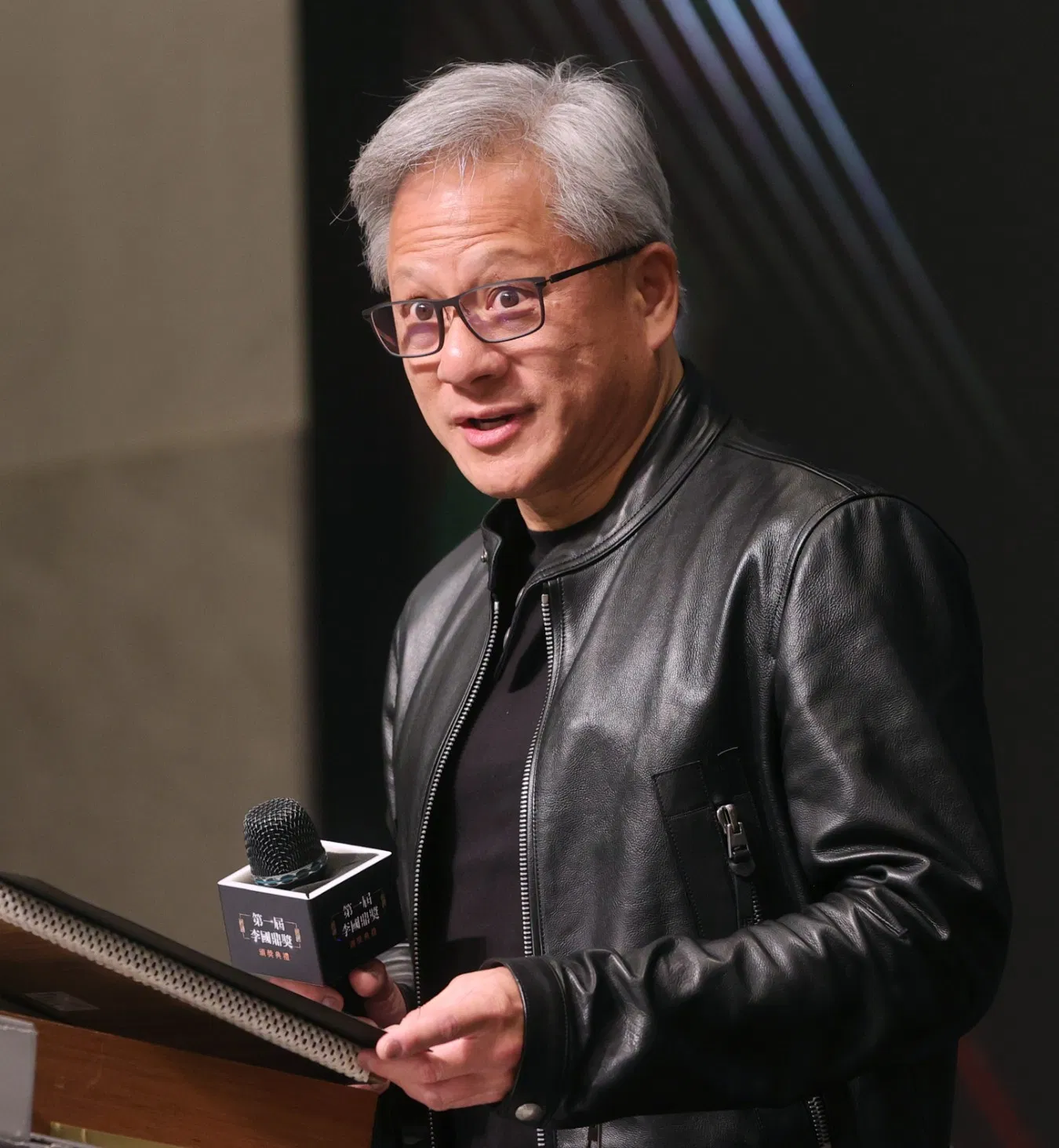
Jensen Huang is the Taiwanese-born American engineer who co-founded Nvidia in 1993 and has led the chipmaker as its chief executive ever since, turning a small startup into the world's first $5 trillion company. Known for his signature black leather jacket and rapid-fire keynote speeches, Huang is one of the richest people on the planet, with a fortune of roughly $158 billion built almost entirely on Nvidia stock. His name recently began trending for another reason: he admitted to an extramarital affair with a business executive whom U.S. officials suspect of ties to Chinese intelligence, a scandal that has triggered an independent company investigation and wiped billions of dollars from his net worth. To understand the man at the center of the story, it helps to know how he built Nvidia — and how the graphics technology he championed became the engine of the modern AI boom.
From Taiwan to Silicon Valley: Jensen Huang's Early Life
Jensen Huang was born Jen-Hsun Huang on February 17, 1963, in Tainan, a city on the southwest coast of Taiwan. When he was young, his family moved to Thailand, and at about age nine his parents sent him and his older brother to the United States to live with relatives in Oneida, Kentucky. The move was difficult: the brothers attended Oneida Baptist Institute, a boarding school where Jensen spent long stretches largely on his own while his brother was away. He later described scrubbing toilets and enduring the school's strict routines, an experience he credits with teaching him discipline.
The family eventually reunited in Oregon, where Huang attended Aloha High School. As a teenager he took a job at a local Denny's restaurant, washing dishes and busing tables. He has often joked that he was Denny's "best dishwasher," and the job holds a special place in Nvidia's origin story — the company was later conceived in a Denny's booth. Huang studied electrical engineering at Oregon State University, where he also met his future wife, Lori Mills, and graduated in 1984. He went on to earn a master's degree in electrical engineering from Stanford University in 1992, after stints designing microprocessors at AMD and later at LSI Logic.

How Nvidia Was Founded in a Denny's Booth
In 1993, Huang teamed up with fellow engineers Chris Malachowsky and Curtis Priem to start a company focused on a then-unproven idea: specialized chips that could make computer graphics faster and more realistic. Legend has it the three sketched out their plans over coffee at a Denny's restaurant in East San Jose, California, starting with just $40,000 in savings. They called the company Nvidia, a play on the Latin word "invidia," meaning envy, and a nod to their next-generation "NV" graphics chip.
Nvidia's early years were rocky. Its first product, the NV1, was a commercial failure, and the company nearly ran out of money. A bet on 3D graphics for the emerging PC gaming market paid off, however, and in 1999 Nvidia released the GeForce 256, which the company marketed as the world's first "graphics processing unit," or GPU. The term stuck, and it became the foundation of an entire industry. Huang has served as president and CEO since day one, making him one of the longest-tenured leaders of a major technology company.
What Nvidia Actually Makes: How a GPU Works
To understand why Nvidia became so valuable, it helps to understand what a GPU actually does. A traditional central processing unit (CPU) is built around a small number of powerful cores — typically four to sixteen — that are optimized to run one complex task after another very quickly. Think of a CPU as a handful of elite chefs, each able to prepare a single complicated dish perfectly, one at a time.
A GPU takes the opposite approach. It contains thousands of smaller, simpler cores — Nvidia calls them CUDA cores, short for Compute Unified Device Architecture — that are designed to break a big job into many tiny pieces and work on them all at the same time. Think of a GPU as thousands of line cooks, each performing one simple step simultaneously. This ability to do many things at once is called parallel processing, and it is what makes GPUs so fast at certain kinds of work.
Originally, that work was rendering images and video for video games, where millions of pixels must be calculated for every frame. Because each pixel can be computed independently, GPUs could paint an entire scene far faster than a CPU. But around 2006, when Nvidia released CUDA, the company opened up its chips to general-purpose computing, letting programmers use the GPU's thousands of cores for any parallel workload — not just graphics. Nvidia later added tensor cores, specialized circuits built for the matrix multiplication at the heart of machine learning.

How GPUs Went From Gaming to Powering AI
Nvidia's pivot from graphics to artificial intelligence was gradual, and it turned out to be one of the most consequential bets in business history. In 2012, a landmark deep-learning model called AlexNet stunned the research world by winning an image-recognition contest using Nvidia GPUs to do the heavy computation. The result convinced researchers that GPUs were ideal for training neural networks, because training an AI model requires performing enormous volumes of parallel calculations — exactly the kind of work GPUs were built for.
Huang leaned into the opportunity. In 2016 he personally delivered the first Nvidia DGX-1, a purpose-built AI supercomputer, to the startup OpenAI, which would later create ChatGPT. As the AI boom accelerated, Nvidia's data-center chips — including the H100 and later the Blackwell architecture — became the standard hardware for training and running large language models. The result was explosive growth: Nvidia became the first chipmaker to reach a $1 trillion valuation in 2023, and in October 2025 it became the first company ever to surpass $5 trillion. In its fiscal 2026, Nvidia reported about $215.9 billion in revenue, with roughly $193.7 billion of that coming from data centers. Huang's personal fortune, which derives almost entirely from his Nvidia shares, climbed past $150 billion along the way.
Why Jensen Huang Is in the News Now
In late October and early November 2026, Huang's name began trending for reasons unrelated to technology. News outlets including The New York Times reported that Huang had a years-long relationship with Alice Huang — also known as Huang Le — a Chinese citizen who served as an executive at a Singapore-based company and whom U.S. officials suspect of ties to Chinese intelligence. On November 8, 2026, Huang acknowledged the affair and apologized to Nvidia employees, while the company's board announced an independent investigation.
The revelation rattled investors. Nvidia's stock fell more than 9% in a single day — its worst decline since the so-called DeepSeek shock of January 2025 — and Huang's net worth dropped by roughly $15.1 billion to about $150.9 billion, briefly pushing him out of the top ten on the world's richest list. The situation also reignited scrutiny of Nvidia's complicated relationship with China, a market that is both a major source of demand for its chips and the subject of strict U.S. export controls. The board's investigation remains ongoing, and its outcome — along with any U.S. government action — will determine what happens next for Huang and for Nvidia.
Key Takeaways: Jensen Huang and Nvidia at a Glance
- Jensen Huang was born Jen-Hsun Huang on February 17, 1963, in Tainan, Taiwan, and moved to the United States as a child.
- He studied electrical engineering at Oregon State University and Stanford, and worked at AMD and LSI Logic before founding Nvidia in 1993 with Chris Malachowsky and Curtis Priem.
- Nvidia created the first GPU — the GeForce 256 — in 1999, and later opened its chips to general-purpose computing with CUDA in 2006.
- GPUs work through parallel processing, using thousands of CUDA cores to perform many calculations at once, which made them ideal for training AI models.
- Nvidia became the world's first $5 trillion company in October 2025, and Huang's fortune peaked above $180 billion.
- In November 2026, Huang admitted to an affair with an executive suspected of ties to Chinese intelligence, triggering an Nvidia board investigation and a sharp drop in the company's stock.