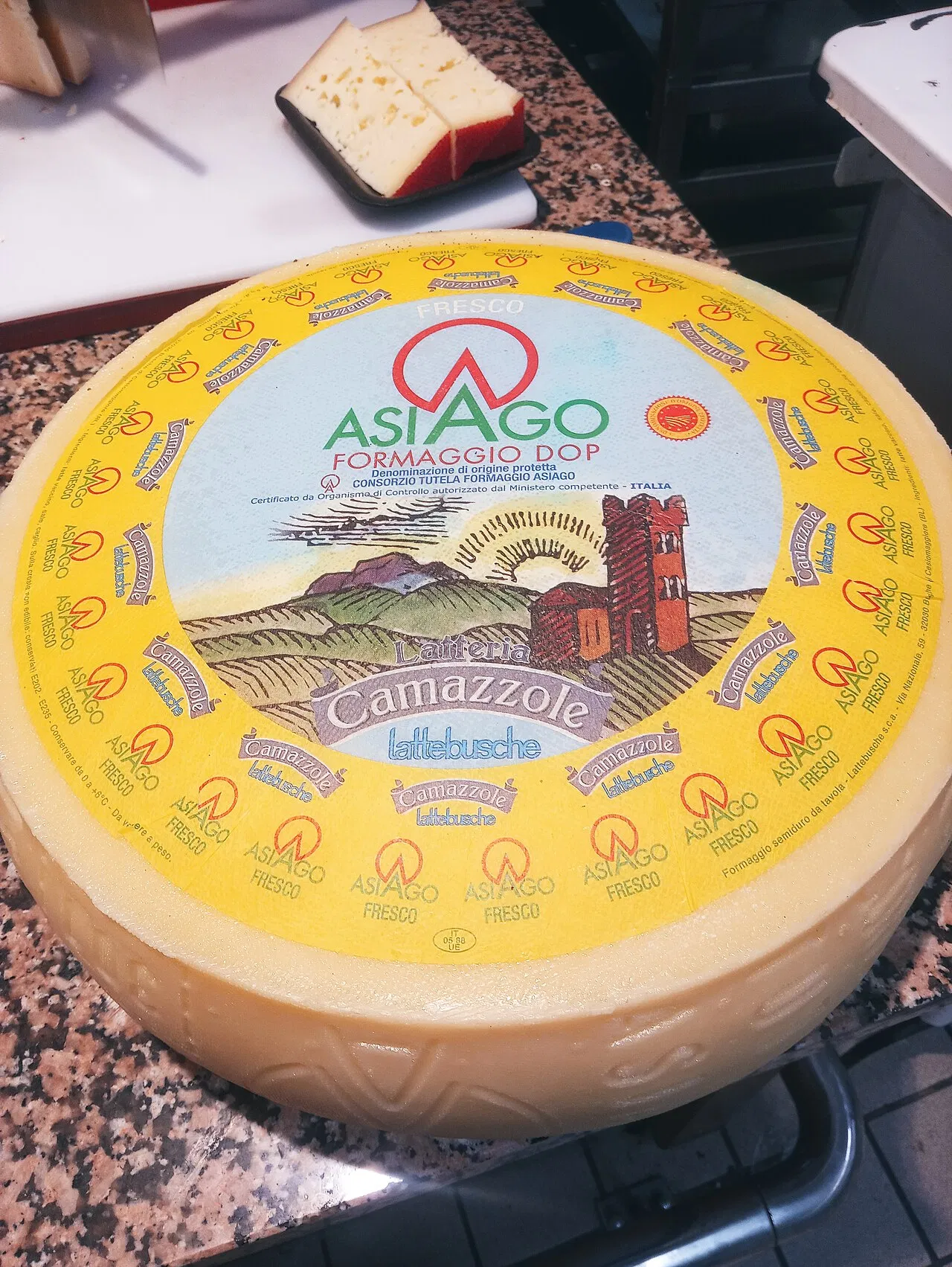
Asiago cheese is a versatile cow's milk cheese from Italy that ranges from smooth and mild when fresh to crumbly and sharp when aged. First produced in the alpine town of Asiago on the Asiago Plateau in the Veneto region of northeastern Italy, this cheese has been crafted for over a thousand years and has become one of Italy's most popular exported cheeses, finding its way onto bagels, into pasta dishes, and onto cheese boards worldwide.
From the Alpine Pastures: The Origins of Asiago Cheese
Asiago's story begins between the 10th and 15th centuries on the high pastures of the Asiago Plateau, a mountainous area in the province of Vicenza. Originally, the cheese was made from sheep's milk and called "Pegorin." The plateau was renowned for its rich pastures, which supported both cheese production and wool manufacturing for the textile mills in nearby valleys like Valdagno and Schio.
By the 18th and 19th centuries, producers had developed Asiago d'Allevo, the aged variety that could be stored for long periods. It wasn't until the early 1900s that Asiago Pressato — the shorter-aged, pressed version — was introduced. Today, Asiago is predominantly made from cow's milk, though the cheese's heartland remains the same: a strictly defined DOP area stretching from the Po Valley meadows up to the Alpine pastures between the Asiago Plateau and the Trentino highlands.
Italian immigrants brought Asiago to the United States in the 1920s, though it remained relatively obscure for decades. It surged in popularity in the late 20th and early 21st centuries, particularly through its use in shredded cheese blends and as the signature topping on the asiago bagel.
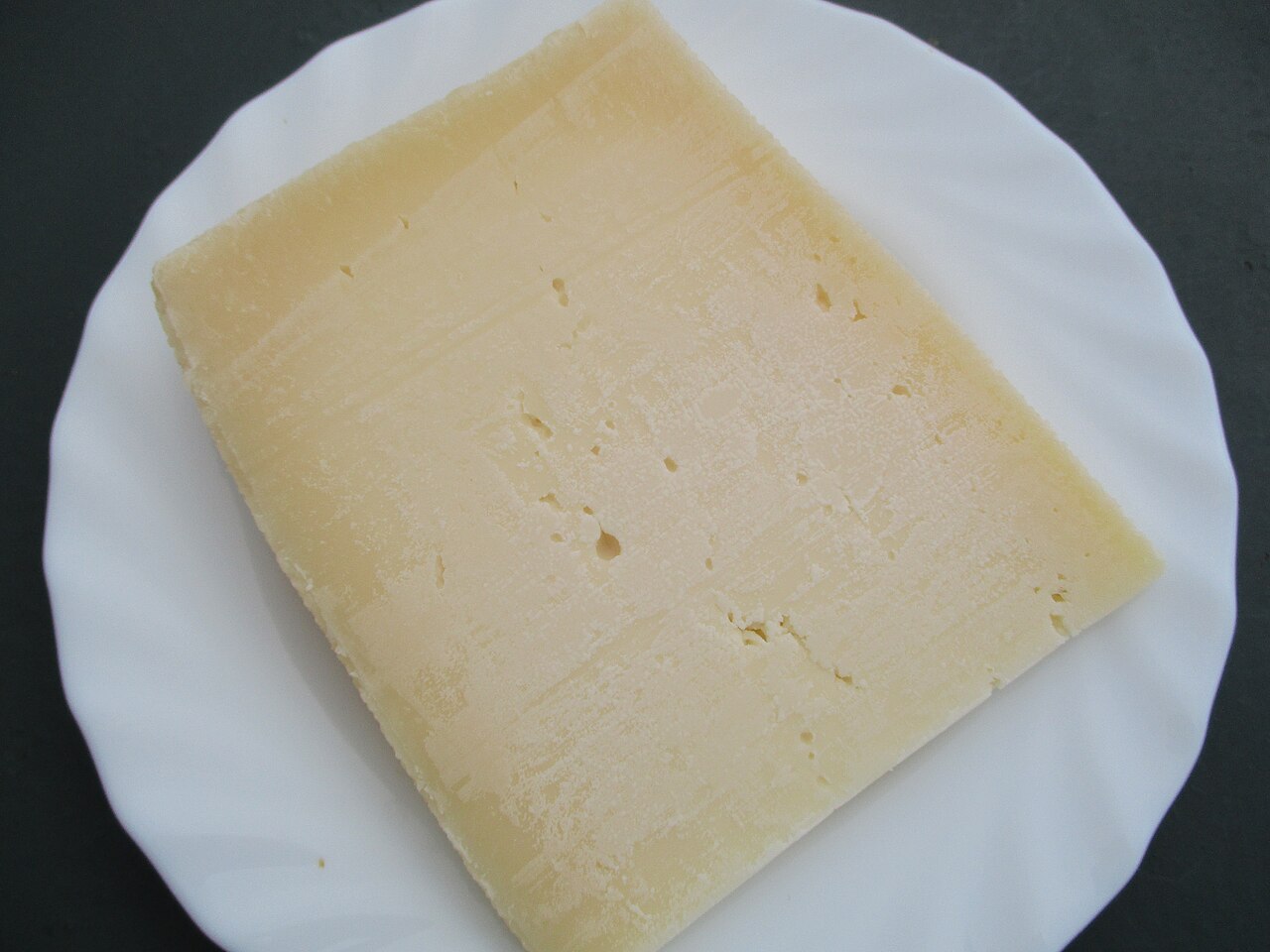
Fresh vs. Aged: The Two Faces of Asiago
Asiago's personality changes dramatically depending on how long it ages. This dual nature is what makes it such a remarkably versatile cheese.
Asiago Pressato (Fresh Asiago) is made from whole cow's milk and aged for only 20 to 40 days. The result is a soft, buttery, slightly elastic cheese with a thin, edible rind. Its paste is white to pale yellow, and its flavor is mild, milky, and delicate. Fresh Asiago is perfect for slicing onto sandwiches, melting into panini, or enjoying on a cheese board with fresh fruit.
Asiago d'Allevo (Aged Asiago) uses a mixture of whole and skimmed milk and is aged for significantly longer. As it matures, the cheese develops a harder, more granular texture and a sharper, more complex flavor profile. The aged varieties are classified by their maturity:
- Asiago Mezzano (middle Asiago): Aged 4 to 6 months, with a compact paste, straw color, and sweetish taste.
- Asiago Vecchio (old Asiago): Aged 10 to 16 months, with a hard paste and a more bitter, pronounced flavor.
- Asiago Stravecchio (very old Asiago): Aged 15 months or more, with a very hard, grainy paste, amber color, and a bitter, spicy kick.
The rind also transforms with age: fresh Asiago has a thin, elastic, straw-colored rind, while aged Asiago develops a thick, hard, brownish-gray rind that is typically not eaten.
How Asiago Cheese Is Made: A Step-by-Step Process
The production methods for fresh and aged Asiago differ in several key ways, though both begin with high-quality cow's milk from the designated production area.
For Asiago Pressato (Fresh): Whole milk is heated to 35°C (95°F). Rennet and lipase enzymes are added to coagulate the milk. The curd is kneaded, partially cooked, and then broken into nut-sized pieces. The mixture is cooked again at approximately 45°C (113°F), then poured into perforated molds. After a first dry salting, the mold is pressed hydraulically for about four hours. The wheels are wrapped with plastic bands bearing the Asiago brand, dried for two to three days, then bathed in brine for two days. Finally, they rest in a dry environment for 20 to 40 days. Each finished wheel weighs 11 to 15 kg (24 to 33 lb) and measures 30 to 40 cm in diameter.
For Asiago d'Allevo (Aged): A mixture of whole and skimmed milk is heated to 35°C. After adding rennet and enzymes, the curd is broken into rice-grain-sized pieces — much smaller than for the fresh version. The curd undergoes two additional cookings at 40°C and 47°C (104°F and 117°F). The curd is extracted, placed into cloth-lined molds, and left to drain. After at least 48 hours of draining with regular turning, the cheese is salted either by dry-salting or brining. Aging then takes place in carefully controlled warehouses (10-15°C, 80-85% humidity) for a minimum of 60 days, with the entire aging process required to occur within the region of origin.
Protected Status and Global Production
Within the European Union, Asiago has enjoyed Protected Designation of Origin (PDO) status since 1996. This means that only cheese produced in the designated area — covering four provinces in northeastern Italy (Vicenza, Trento, and parts of Padua and Treviso) — and made according to the strict production discipline can legally be called Asiago DOP in Europe. Cheese produced in mountain dairies above 600 meters (2,000 ft) elevation can earn an additional "Product of the Mountains" label.
Outside the EU, the situation is different. The United States Patent and Trademark Office has repeatedly ruled that "asiago" is a generic term describing a style of cheese, not a unique Italian product. In 2019, the Consorzio Tutela Formaggio Asiago abandoned efforts to trademark the name in the U.S. after the USPTO rejected the application on genericness grounds. Australia's IP office reached a similar conclusion in 2018. As a result, Asiago-style cheese is now produced in countries including the United States and Australia, often with excellent results — Wisconsin cheesemakers have won more than 100 awards for their American-style Asiago.
Culinary Uses: How to Enjoy Asiago Cheese
Asiago's two textures make it a remarkably adaptable kitchen ingredient. Fresh Asiago Pressato is ideal for slicing and melting. Use it on panini and sandwiches, melt it over grilled vegetables, or cube it for antipasti platters. It pairs beautifully with fresh fruits like cantaloupe and figs, and with light, crisp white wines.
Aged Asiago d'Allevo shines as a grating cheese. Grate it over pasta, risotto, salads, soups, and sauces in the same way you would use Parmesan or Grana Padano — though aged Asiago has a distinctive nutty, slightly sharper character that sets it apart. Asiago Vecchio and Stravecchio can also be shaved onto salads or served in chunks alongside cured meats and olives on a charcuterie board. The cheese also stars in baked dishes like Asiago bread, creamy risotto with lemon and rosemary, spinach and artichoke dip, and the classic Italian frico — crispy baked Asiago cheese crisps.
Key Takeaways About Asiago Cheese
- Asiago is an Italian cow's milk cheese from the Veneto region, with over 1,000 years of cheese-making tradition
- It comes in two main forms: fresh Asiago Pressato (smooth, mild, aged 20-40 days) and aged Asiago d'Allevo (crumbly, sharp, aged 4 months to 2+ years)
- The aged variety has three sub-types: Mezzano (4-6 months), Vecchio (10-16 months), and Stravecchio (15+ months)
- Asiago holds PDO status in the EU but is produced globally as a generic cheese style in the U.S. and Australia
- Fresh Asiago is best for slicing and melting; aged Asiago is perfect for grating over pasta, salads, soups, and sauces