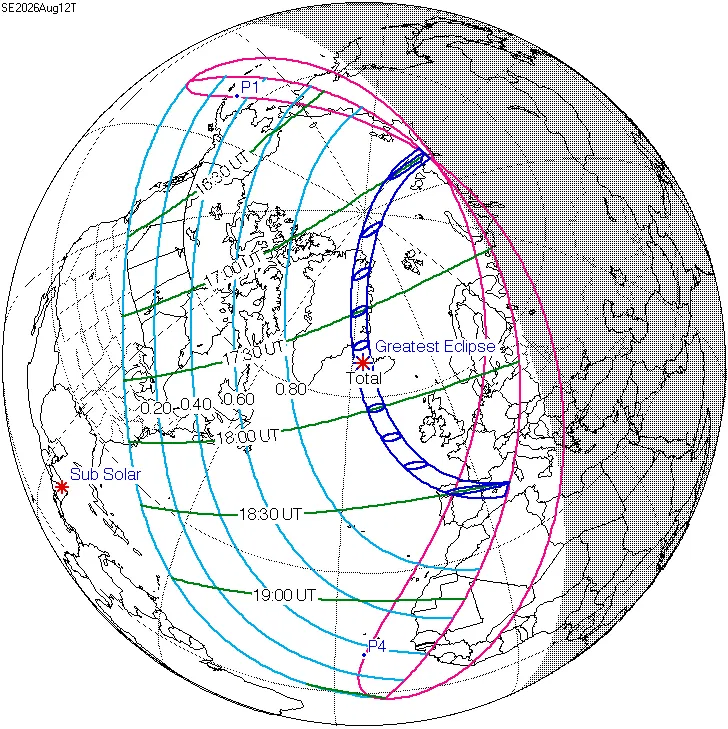
On August 12, 2026, one of nature's most spectacular phenomena will unfold as the Moon passes directly between the Earth and the Sun, casting a shadow that will race across the Arctic, Greenland, Iceland, and northern Spain. This total solar eclipse — the first to touch continental Europe in two decades — will plunge parts of the world into an eerie daytime darkness for up to 2 minutes and 18 seconds. Whether you are an avid eclipse chaser or simply curious about how these rare events happen, here is everything you need to know about the science behind solar eclipses, exactly where the 2026 eclipse will be visible, and how to experience it safely.
What Exactly Is a Solar Eclipse — and Why Does It Happen?
A solar eclipse occurs when the Moon moves between the Earth and the Sun, partially or completely blocking the Sun's light from reaching a portion of the Earth's surface. This can only happen during a new moon, when the Moon's orbit places it directly between our planet and our star.
However, solar eclipses do not happen every month because the Moon's orbit around Earth is tilted by about 5 degrees relative to Earth's orbit around the Sun. Most new moons pass slightly above or below the Sun from our perspective. An eclipse only occurs when a new moon happens while the Moon is crossing the plane of Earth's orbit — at points called the lunar nodes.
There are four types of solar eclipses. A total solar eclipse happens when the Moon completely covers the Sun, revealing the Sun's glowing outer atmosphere, called the corona. An annular solar eclipse occurs when the Moon is slightly too far from Earth to fully cover the Sun, leaving a bright ring — or annulus — of sunlight visible. A partial solar eclipse happens when the Sun, Moon, and Earth are not perfectly aligned, so only part of the Sun is covered. Finally, a hybrid solar eclipse is the rarest type, shifting between annular and total along different points of the eclipse path.
The August 2026 eclipse will be a total solar eclipse — and an especially favorable one because it occurs about 2.2 days after the Moon reaches perigee, its closest point to Earth. This means the Moon will appear slightly larger in the sky, maximizing the duration of totality.
Where Will the 2026 Total Solar Eclipse Be Visible?
The path of totality for the August 12, 2026 eclipse will be a narrow corridor approximately 294 kilometers (183 miles) wide. The eclipse will begin at sunrise in northern Siberia, Russia, then sweep westward across the Arctic Ocean — an unusual east-to-west trajectory caused by the eclipse occurring near the North Pole. The Moon's shadow will then pass over northern Greenland, cross Iceland, travel across the Atlantic Ocean, and finally reach continental Europe over northern Spain and a small corner of northeastern Portugal before ending at sunset in the Mediterranean near the Balearic Islands.
Several major Spanish cities lie within the path of totality, including A Coruña, Valencia, Zaragoza, Palma de Mallorca, and Bilbao. Notably, both Madrid and Barcelona will sit just outside the path and will experience only a partial eclipse. In Iceland, the best viewing locations include Ísafjörður, Látrabjarg, and Borgarnes, with the longest totality — 2 minutes and 13 seconds — occurring at Látrabjarg on Iceland's westernmost point.
A deep partial eclipse covering more than 90% of the Sun will be visible across Ireland, Great Britain, Portugal, France, Italy, the Balkans, and North Africa. Most of Europe, along with parts of West Africa and northern North America, will see a partial eclipse with varying degrees of coverage.
A Once-in-a-Lifetime Event for Iceland and Spain
The 2026 eclipse carries special significance for several regions. For Iceland, this will be the first total solar eclipse visible from the island nation since June 30, 1954 — a gap of 72 years. It will also be the only total solar eclipse to touch Iceland in the entire 21st century; the next one will not occur until 2196.
Spain is entering what astronomers are calling a remarkable eclipse era. The country's last total solar eclipse happened on August 30, 1905, meaning Spaniards have waited 121 years for this moment. But the wait comes with a bonus: Spain will experience a rare hat-trick of total solar eclipses in three consecutive years — August 12, 2026, followed by August 2, 2027 (crossing southern Spain and Gibraltar), and then another on July 22, 2028 (visible from parts of Spain and the Balearic Islands).
For continental Europe, this will be the first total solar eclipse since March 29, 2006 — and the first in the continental European Union since the famous eclipse of August 11, 1999, which drew millions of observers across Europe.
NASA's High-Flying Eclipse Mission
NASA plans to take advantage of the 2026 eclipse with a dedicated research mission. The agency will deploy one of its WB-57 high-altitude research aircraft to chase the Moon's shadow over the North Atlantic Ocean. Flying at 50,000 feet — well above any cloud cover and atmospheric interference — the WB-57 will travel at approximately 460 miles per hour (400 knots), effectively extending the period of totality from 2 minutes and 18 seconds on the ground to nearly 3 minutes for the instruments on board.
The aircraft will carry four specialized cameras designed to capture the Sun's corona in various wavelengths of visible and infrared light. Scientists hope this data will help answer fundamental questions about the solar corona's extreme temperature — which, at millions of degrees, is far hotter than the Sun's surface — and the mechanisms that drive the solar wind, the stream of charged particles that constantly flows outward from the Sun.
How to View a Solar Eclipse Safely
Looking directly at the Sun — even during a partial eclipse — can cause permanent eye damage or blindness. The only time it is safe to view a solar eclipse with the naked eye is during the brief moments of totality, when the Moon completely blocks the Sun's bright face. At all other times, including during the partial phases before and after totality, proper eye protection is essential.
The safest way to view a partial solar eclipse is through ISO-certified solar viewing glasses (ISO 12312-2 standard) or through a handheld solar viewer. Regular sunglasses — no matter how dark — are never safe for viewing the Sun. Alternatively, you can use an indirect viewing method such as a pinhole projector: simply punch a small hole in a piece of cardstock, hold it up to the Sun, and project the Sun's image onto a flat surface. Never look at the Sun through an unfiltered camera, telescope, binoculars, or any other optical device, as these can concentrate sunlight and cause instant and severe eye damage.
For those planning to travel to the path of totality, local weather conditions in August will play a significant role. Northern Spain typically offers favorable conditions with lower cloud cover in August, though Iceland and the Arctic regions carry a higher risk of overcast skies. Eclipse chasers often have backup viewing locations and monitor weather forecasts in the days leading up to the event.
The Bottom Line: What You Need to Remember
- The total solar eclipse of August 12, 2026 will be visible along a narrow path crossing Siberia, the Arctic, Greenland, Iceland, and northern Spain.
- Maximum totality will last 2 minutes and 18 seconds at a point just off Iceland's western coast.
- This is the first total solar eclipse in Iceland since 1954 and the first in continental Europe since 2006.
- Spain is entering a rare triple-eclipse era with total solar eclipses in 2026, 2027, and 2028.
- Viewing a solar eclipse requires ISO-certified solar glasses or an indirect projection method at all times except during the brief window of totality.
- NASA will fly a WB-57 research aircraft to study the Sun's corona during the eclipse, extending observation time to nearly 3 minutes.