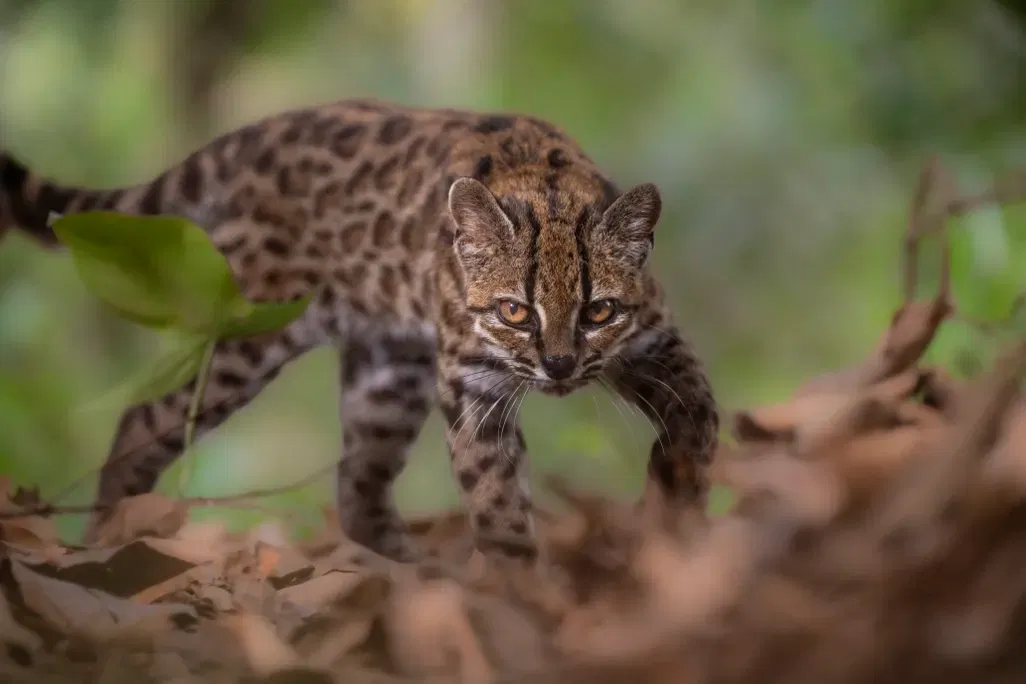
Scientists have confirmed the first brand-new species of wild cat in more than a century: the tilcayo (Leopardus tilcayo), a tiny, spotted feline native to the cloud forests of Bolivia. Smaller than a house cat and covered in large, irregular rosettes, the tilcayo was hiding in plain sight for years—known to local communities by name but never recognized by science as a distinct species until a genetic study published in September 2026.
The discovery, reported in the journal Current Biology on September 17, 2026, marks the first time researchers have formally described a completely new living cat species since the pampas cat was identified in 1923. It is a vivid reminder that even familiar-looking animals can conceal surprising genetic secrets.
What Is the Tilcayo?
The tilcayo is a species of small wild cat in the genus Leopardus, the group that also includes ocelots, margays, and Geoffroy's cat. Its scientific name, Leopardus tilcayo, honors the name that local communities in Bolivia's Yungas region have used for the animal for generations.
It belongs to a group of small spotted cats collectively known as “tiger cats.” For decades, scientists treated these lookalike felines as a single species, the oncilla or northern tiger cat (Leopardus tigrinus). The new research shows the tiger cat family is far more diverse than anyone realized—and the tilcayo is its newest member.
The name is pronounced til-KYE-oh. Its exact meaning has been lost to time: it does not appear to come from Spanish or Quechua, and when researchers asked local people about its origin, they were told simply that grandparents had always called the cat by that name.
How a Roadside Kitten Became a New Species
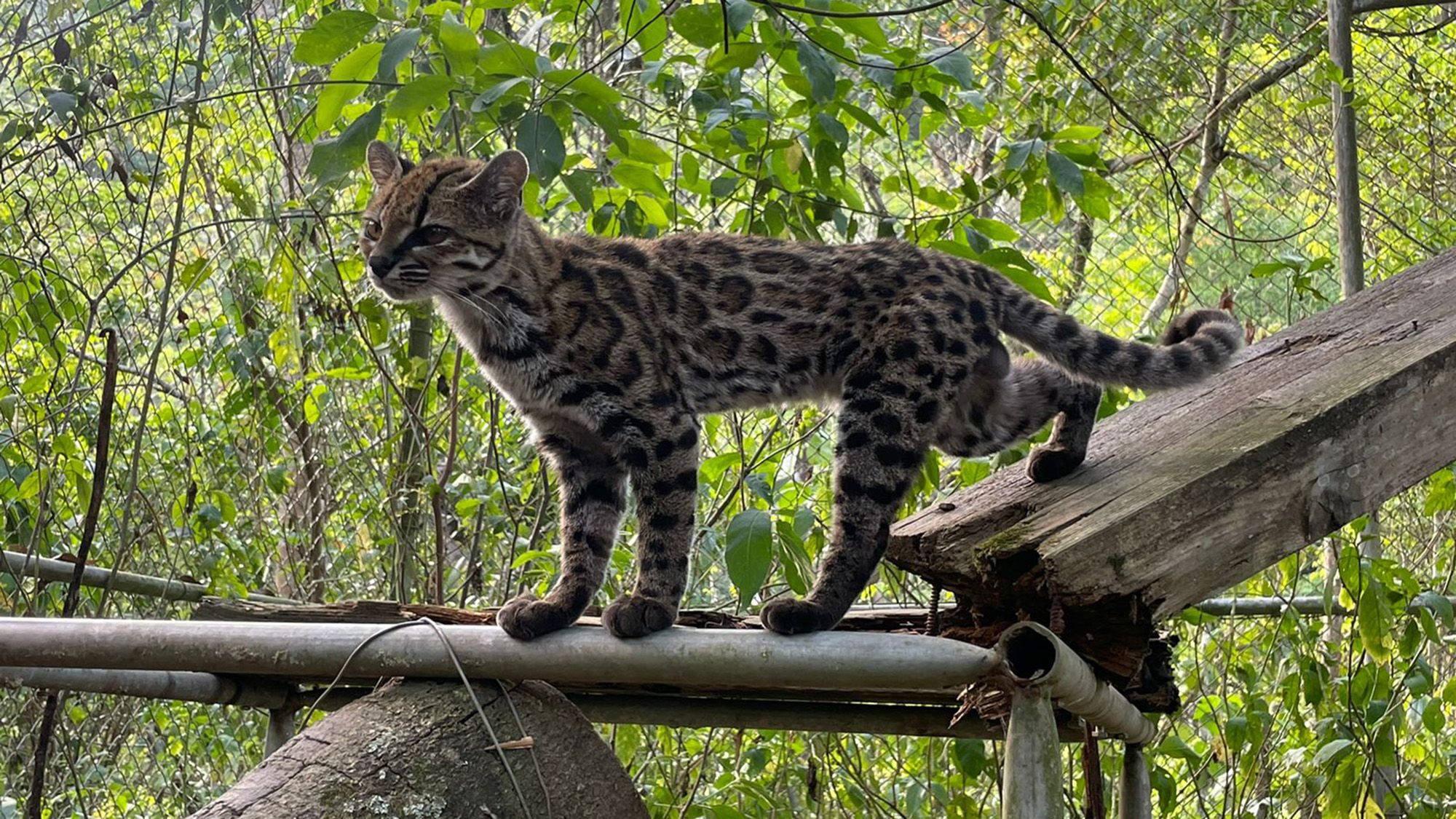
The tilcayo's discovery story began around 2016, when a man found a tiny cat on a road in the forest near La Paz, Bolivia. Believing it was a stray domestic kitten, he took it home and began feeding it noodles, rice, and eggs. About a year later, he realized the animal was probably wild and brought it to the Senda Verde Wildlife Sanctuary, a nonprofit rescue center.
That is where biologist Paola Nogales-Ascarrunz, a National Geographic Explorer and founder of the Bolivian Felids Research Program, first saw the mysterious animal—a male nicknamed “Tigrino” with rounded ears, a small face, and big, leopard-like spots. At first she suspected it was a northern tiger cat, but the cat was too small, its rosettes too large, and its tail looked different.
“It didn't really match,” Nogales-Ascarrunz told The New York Times. Genetic testing confirmed her hunch: the unusual cat belonged to a separate species previously unknown to science. A genetic analysis of 38 cats from the Leopardus genus revealed that the tilcayo split from the rest of the tiger cat lineage roughly 1.4 million years ago, during the Early Pleistocene.
Unlike many recent additions to the cat family tree—which come from elevating an existing subspecies or splitting a known species—the tilcayo is genuinely new to science. It is the first brand-new feline identified since the pampas cat in 1923.
What the Tilcayo Looks Like
The tilcayo is diminutive. Adults measure about 42.5 to 50 centimeters (17 to 20 inches) from head to body, with a tail of roughly 25 to 26.5 centimeters (10 to 10.5 inches). They weigh just 1.5 to 2 kilograms (about 3 to 4 pounds), considerably smaller than the average house cat.
Its coat is light brown and dotted with large, dark-brown-to-black rosettes that are mostly open or partially closed rather than solid. Its rosettes stay distinct rather than merging into stripes. The cat also has short, rounded ears, long whiskers, and a compact, scrunched-up face.
These subtle features help explain why the tilcayo stayed hidden for so long. Tiger cats are what biologists call “cryptic species”: different tiger cat species look so similar to one another that they are nearly impossible to tell apart by appearance alone. Only DNA can reliably separate them.
Where It Lives and What It Eats
The tilcayo was found near the town of Arapata in Bolivia's Nor Yungas province, at an elevation of about 1,570 meters (5,150 feet). This is the heart of the Yungas, a humid cloud forest on the eastern slopes of the Andes where the mountains meet the Amazon basin.
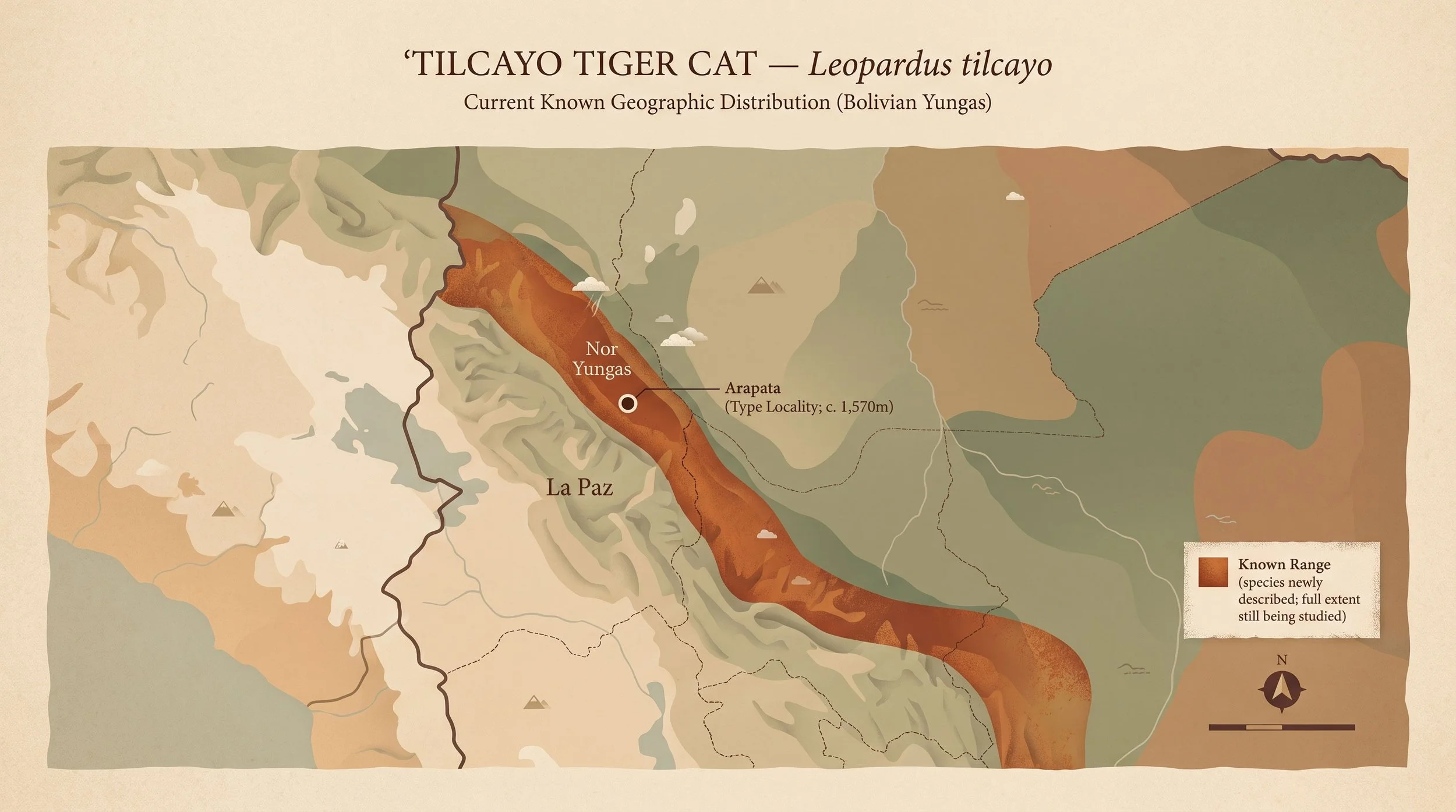
Because the cats are small, shy, and elusive, researchers still know very little about their daily lives. Scat samples suggest the tilcayo eats small rodents, and wildlife camera footage hints that it may be mostly active at night. Its full diet, hunting habits, social behavior, and lifespan remain open questions.
Why the Tilcayo Stayed Hidden for So Long
The study that revealed the tilcayo also redrew the tiger cat family tree. By analyzing the DNA of 38 cats—including 26 individuals from the tiger cat complex—researchers concluded that what was once treated as a single species actually contains five distinct species:
- The northern tiger cat (Leopardus tigrinus)
- The southern tiger cat (Leopardus guttulus)
- The clouded tiger cat (Leopardus pardinoides)
- The eastern tiger cat (Leopardus emiliae)
- The newly named tilcayo (Leopardus tilcayo)
The team also identified a new subspecies, Leopardus tigrinus antisuyo, found in Peru's Yungas. Jonas Lescroart, an evolutionary ecologist at the University of Antwerp and co-lead author of the study, called the work “the most complete genetic study yet” of tiger cats.
So why did the split happen? About 1.4 million years ago, during the Early Pleistocene, the climate fluctuated dramatically. As glaciers advanced and retreated, tropical lowland forests turned into dry savannas, while the moist montane cloud forests held onto their humidity and acted as “climatic refugia.” This fragmentation isolated different tiger cat populations, setting the stage for them to evolve into separate species over time.
What the Discovery Means for Conservation
Finding a new cat species is exciting, but it also carries a warning. When one “widespread” species is split into several, each turns out to have a smaller population and range—and is therefore more vulnerable than it first appeared.
“Once three species become five species, each population is reduced,” Jim Sanderson, founder of the Small Wild Cat Conservation Foundation, told National Geographic. “Therefore, conservation efforts must increase, perhaps urgently, depending on estimated population sizes.”
Scientists do not yet know how many tilcayos exist in the wild, and the species has not been formally assessed by the IUCN Red List. Like other cloud forest animals, it faces threats from deforestation, habitat fragmentation, disease, and wildlife trafficking.
What Happens Next
The next steps involve learning the basics about a species that has never been studied. Field surveys and camera traps will help estimate how many tilcayos remain and map the full extent of their range. Researchers will also work to understand the cat's diet, reproduction, and behavior in the wild.
In time, the tilcayo will need a formal conservation assessment, which could lead to legal protections in Bolivia and international listings under CITES, the treaty that regulates wildlife trade. For now, the discovery stands as proof that the natural world still holds secrets—and that local knowledge can be as valuable as laboratory science.
“Our world is extremely complex,” Nogales-Ascarrunz said. “Sometimes we think that most of it is known, that there's not a whole lot to discover, but in fact, it's the other way around.”
Key Takeaways
- The tilcayo (Leopardus tilcayo) is the first brand-new wild cat species described since 1923.
- It lives in the cloud forest of Bolivia's Yungas and is smaller than a house cat, weighing about 3 to 4 pounds.
- It was identified through a genetic study of tiger cats published in Current Biology in September 2026.
- The discovery split the tiger cat family into five distinct species, each with a smaller and more vulnerable population.
- Researchers still know little about the tilcayo's diet, behavior, and population size, making it a priority for future study and conservation.