The Kentucky Derby, often called "The Most Exciting Two Minutes in Sports," is far more than just a horse race. Run annually at Churchill Downs in Louisville, Kentucky, this Grade I stakes race for three-year-old Thoroughbreds has captivated audiences since 1875. The 152nd running took place on May 2, 2026, with Golden Tempo making history — but how exactly does this iconic event work, and what makes it so special?
The Road to the Derby: How Horses Qualify
Getting into the Kentucky Derby isn't as simple as showing up and entering. Since 2013, horses have qualified through the "Road to the Kentucky Derby" — a points-based system that determines which 20 horses earn a spot in the starting gate. Horses earn points by finishing in the top five positions in designated prep races held across the United States and occasionally internationally.
The prep races are divided into two series. The Kentucky Derby Championship Series includes the most prestigious prep races offering the most points: the winner of a 100-point race (like the Florida Derby or Santa Anita Derby) earns 100 points, the second-place finisher gets 40, third gets 20, fourth gets 10, and fifth gets 5. The earlier prep races in the series award fewer points. Historically, horses need at least 40 points to secure a spot in the 20-horse field, though this varies yearly depending on competition.
Once qualified, each horse must meet specific requirements. All runners are three-year-old Thoroughbreds — no older, no younger. Colts and geldings carry 126 pounds (57 kg), while fillies carry 121 pounds (55 kg). The race distance is 1 1/4 miles (10 furlongs), shortened from 1 1/2 miles in 1896 to match changing standards in American racing.
From 1875 to Today: A Rich History
The Kentucky Derby traces its origins to Meriwether Lewis Clark Jr., grandson of explorer William Clark. In 1872, Clark traveled to England and attended the Epsom Derby, then visited Paris to see the Grand Prix de Paris at Longchamp. Inspired, he returned to Louisville and organized the Louisville Jockey Club to raise funds for a racetrack on land provided by John and Henry Churchill. That track became Churchill Downs, and the first Derby was run on May 17, 1875, before an estimated crowd of 10,000 people.
A field of 15 horses contested that first race, which was won by Aristides, ridden by jockey Oliver Lewis. Notably, 13 of the 15 jockeys in that inaugural Derby were Black — a fact often overlooked in modern discussions. Black jockeys dominated the Derby in its early decades, winning 15 of the first 28 runnings. Isaac Murphy became the first jockey to win three Derbies, and Jimmy Winkfield won back-to-back in 1901 and 1902 before becoming the last Black jockey to win the race. By 1911, Black jockeys had disappeared from the Derby entirely due to racial discrimination and violence on the track.
The track itself faced financial difficulties shortly after opening, but a syndicate led by Colonel Matt Winn acquired Churchill Downs in 1902. Under Winn's leadership, the Derby grew into the premier Thoroughbred race in North America. In 1931, the race was permanently moved to the first Saturday in May, establishing the order of the Triple Crown: the Kentucky Derby first, followed by the Preakness Stakes and Belmont Stakes.
The Traditions That Define the Derby
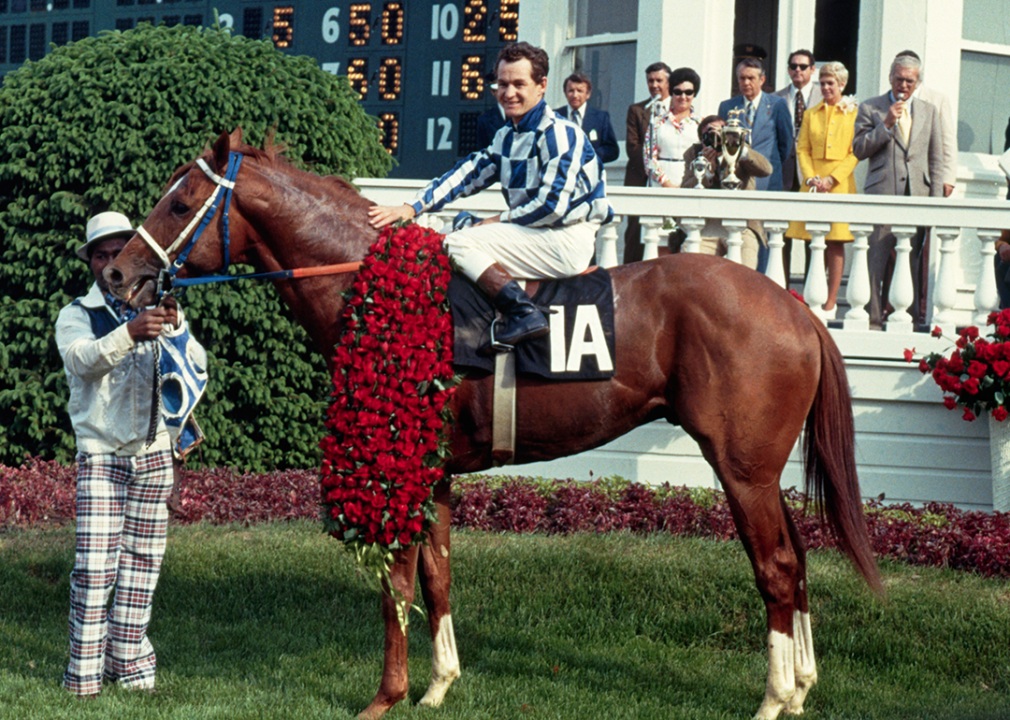
The Kentucky Derby is as much about tradition as it is about speed. The race has been called "The Run for the Roses" since 1925, when sportswriter Bill Corum popularized the phrase. The tradition of draping the winner in roses dates back to 1896, when the red rose became the race's official flower. Today, a lush blanket of 554 red roses is presented to the winning horse in the winner's circle.
As the horses parade before the grandstands, the University of Louisville Cardinal Marching Band plays Stephen Foster's "My Old Kentucky Home" — a tradition that began in 1921. The song stirs emotions among the 150,000+ spectators, many of whom sing along while the horses walk toward the starting gate.
The mint julep — a refreshing cocktail of bourbon, mint, sugar, and crushed ice served in a silver cup — has been the Derby's signature drink since the early 20th century. Churchill Downs serves approximately 120,000 mint juleps over Derby weekend. The elaborate hats worn by attendees are another beloved tradition, with women and men alike donning everything from wide-brimmed fascinators to whimsical, flower-laden creations.
In the final moments before the race, the bugler plays "The Call to the Post," and a celebrity announcer commands "Riders Up!" — the traditional signal for jockeys to mount their horses. Recent "Riders Up" announcers have included Martha Stewart (2024), Simone Biles (2025), and Hall of Fame jockey Pat Day (2026).
The Race Structure: What Happens on Derby Day
Derby Day at Churchill Downs is a full-day event. Gates open at 8 a.m. ET, and the first race typically begins around 10:30 a.m. The Kentucky Derby itself is the 12th or 13th race on the card, usually going off around 6:57 p.m. ET. The entire undercard features 10-13 supporting stakes races, including the Kentucky Derby itself.
The 20 horses load into a specialized starting gate — a single 20-stall gate introduced in 2020 that replaced the previous arrangement of a 14-stall gate and an auxiliary 6-stall gate. When the gates spring open, the horses race 1 1/4 miles counterclockwise around the dirt track. The race typically lasts about two minutes, hence the nickname "The Most Exciting Two Minutes in Sports."
Churchill Downs can accommodate over 150,000 spectators. The most expensive seats are in Millionaire's Row, while the infield offers general admission for revelers who want to party. A giant 4K video board installed in 2014 ensures everyone can see the action.
Records and Notable Moments
The fastest time in Derby history belongs to Secretariat, who ran the 1 1/4 miles in 1:59.4 in 1973 — a record that still stands today. That same year, Secretariat did something unprecedented: each successive quarter-mile was run faster than the previous one, a feat no other horse has matched. The second horse, Sham, also ran under two minutes, an unofficial achievement.
The highest odds ever for a winning horse belong to Donerail, who won at 91-1 odds in 1913. In 2022, Rich Strike won at 80-1 odds, the second-highest in history. Only three horses have won the Derby without racing as two-year-olds: Apollo (1882), Justify (2018), and Mage (2023).
The most successful jockey in Derby history is Eddie Arcaro, who won five times (1938, 1941, 1945, 1948, 1952), tied with Bill Hartack (1957, 1960, 1962, 1964, 1969). Ben Jones and Bob Baffert share the trainer record with six wins each. Calumet Farm holds the owner record with eight wins.
The 2026 Derby: A Historic Running
The 152nd Kentucky Derby took place on Saturday, May 2, 2026, with a purse of $5 million — $3.1 million going to the winner. Golden Tempo won the race, giving trainer Cherie DeVaux a place in history as the first female trainer ever to win the Kentucky Derby. Jockey Jose Ortiz was aboard the winner.
Derby Week 2026 kicked off on April 25 with Opening Day at Churchill Downs, followed by "Thurby" on Thursday, the Kentucky Oaks (for three-year-old fillies) on Friday, and the main event on Saturday. The Kentucky Derby Festival, a two-week celebration leading up to the race, included Thunder Over Louisville — one of the nation's largest annual fireworks displays — along with the Great Steamboat Race, the Pegasus Parade, and numerous other community events.
Where Things Stand: The Future of the Derby
The Kentucky Derby continues to evolve while honoring its traditions. The purse has grown from $1 million in 1996 to $5 million in 2024, reflecting the race's enduring popularity. Attendance regularly exceeds 150,000, and billions of dollars are wagered on the race worldwide each year.
Looking ahead, the 2027 Kentucky Derby is scheduled for May 1, 2027. The Road to the Kentucky Derby points series will begin in the summer of 2026, with prep races running through the following April. As always, only 20 three-year-old Thoroughbreds will earn the right to compete for the blanket of roses in what remains America's most celebrated horse race.
Key Takeaways: Everything You Need to Know
- The Kentucky Derby is held annually on the first Saturday in May at Churchill Downs in Louisville, Kentucky
- Only 20 three-year-old Thoroughbreds qualify through the Road to the Kentucky Derby points system
- The race distance is 1 1/4 miles and typically lasts about two minutes
- The winner receives a blanket of 554 red roses and a share of the $5 million purse
- Secretariat holds the speed record at 1:59.4 (1973)
- The 152nd running in 2026 was won by Golden Tempo, trained by the first female winning trainer Cherie DeVaux
- Key traditions include mint juleps, elaborate hats, "My Old Kentucky Home," and the "Riders Up!" command